
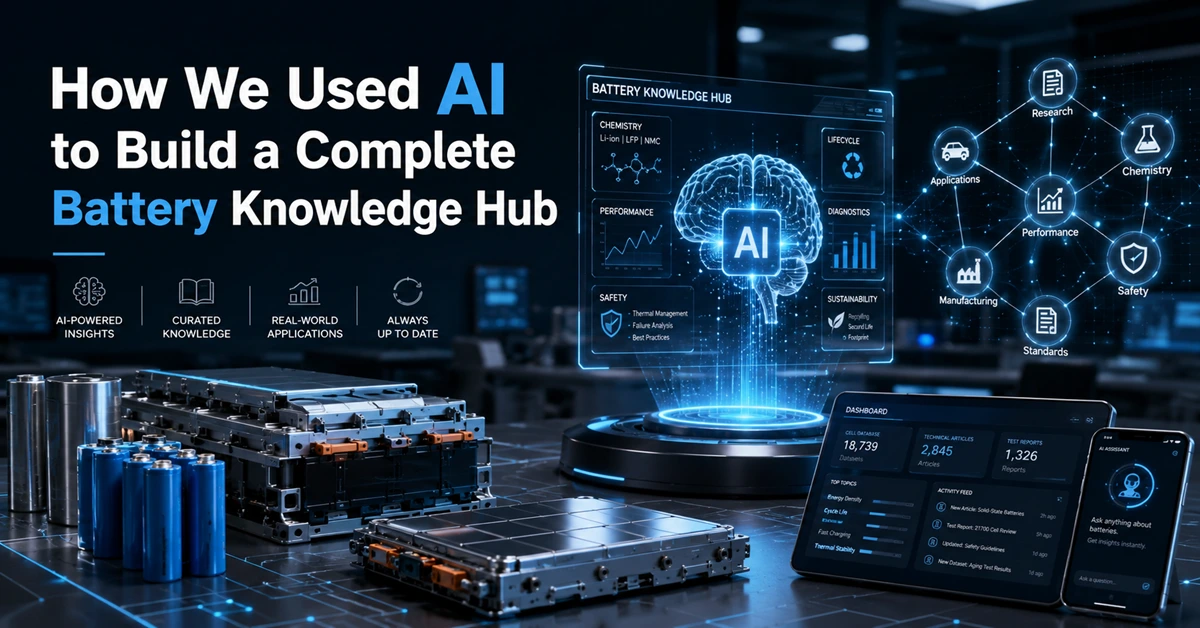
AI did not replace our SEO topic cluster strategy. It helped us work faster, organize ideas more clearly, and turn a single battery category into a structured topic cluster. This case study shows how we used AI, keyword research, search intent analysis, and industry knowledge to build a complete battery knowledge hub from the ground up.
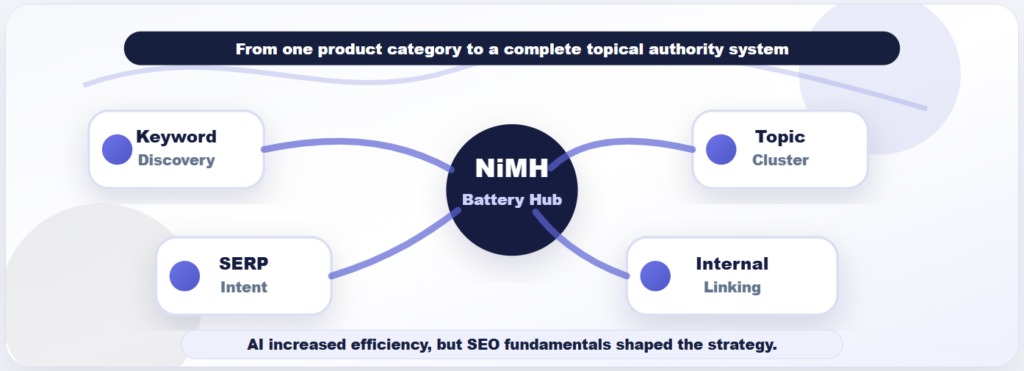
We are a battery manufacturing company with multiple product lines, including lithium batteries, NiMH batteries, alkaline batteries, and carbon-zinc batteries. But when the new website launched, our resources were limited. Instead of trying to cover every battery category at once, we made a strategic decision: focus on one topic first, build it deeply, and then expand into other categories later.
The first topic we selected was NiMH Battery. It had a mature product foundation, stable search demand, moderate competition, and a wide range of real-world applications. That made it the ideal starting point for building topical authority through a structured content system.
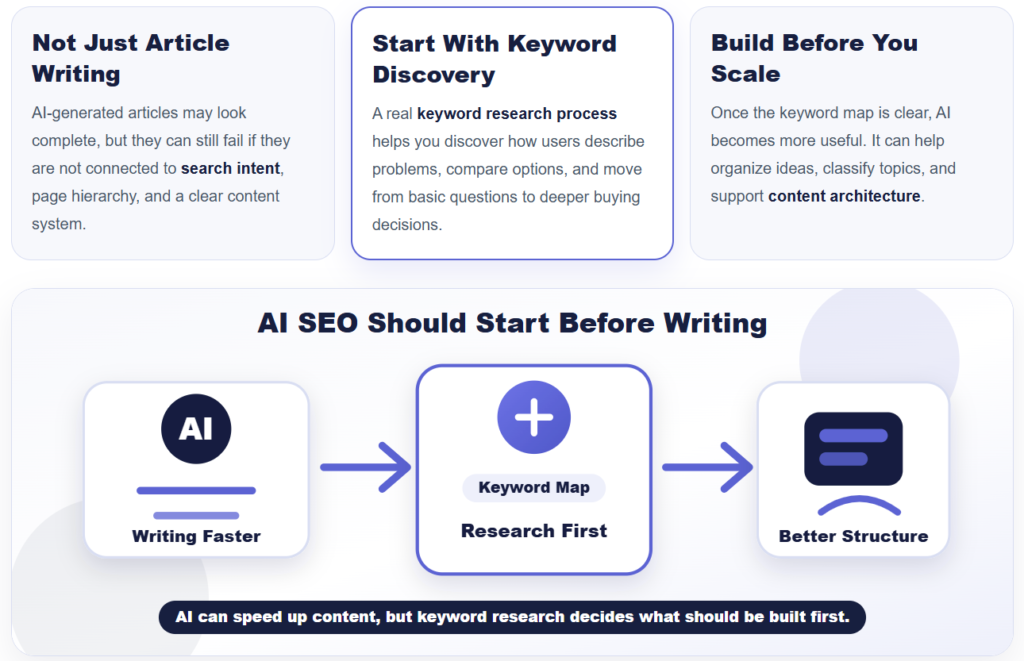
AI Does Not Start With Writing Articles
When many people talk about AI and SEO, they immediately think about using AI to write articles, generate titles, or create meta descriptions. Those tasks can save time, but they are not the real starting point of a serious SEO strategy.
If you begin with writing, you may simply create more content without knowing whether that content belongs inside the right topic cluster, supports the right user intent, or connects to the right parent page. In other words, AI can help you produce faster, but speed is not useful if the structure is wrong.
For our manufacturing website, the first step was not asking AI to write a blog post. The first step was keyword research: finding the full search landscape around one product category, understanding what users actually search for, and deciding how those searches should become a structured knowledge system.
Start by Mapping the Entire Search Demand
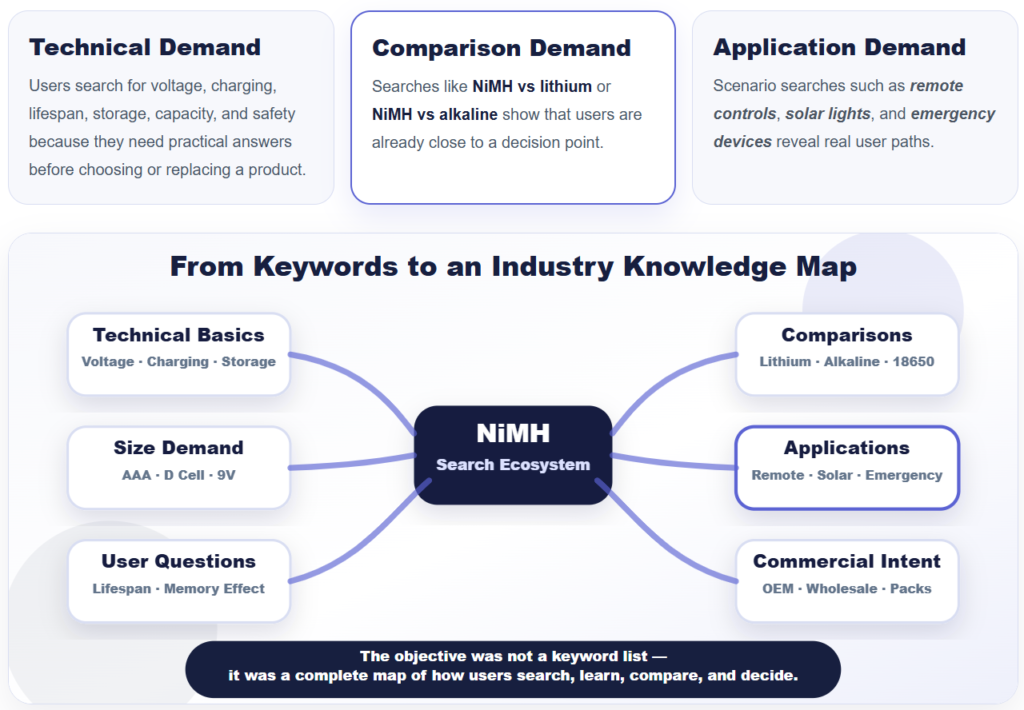
The first real step was not writing content. It was understanding the full search demand behind one product category. Instead of choosing a few obvious keywords, we tried to collect every meaningful user query related to NiMH, then understand how those queries connected to each other.
This included technical searches such as NiMH voltage, NiMH charging, NiMH storage, NiMH lifespan, and NiMH memory effect. It also included comparison searches such as NiMH vs lithium, size-based searches such as AAA NiMH, D cell NiMH, and 9V NiMH, plus application searches like remote control batteries and solar light batteries.
The goal was not to build a keyword list. A keyword list is flat. What we needed was a complete industry knowledge map: a structure that shows how users move from basic understanding to technical research, product comparison, application selection, and commercial decisions.
Use Google SERPs to Understand Real User Intent
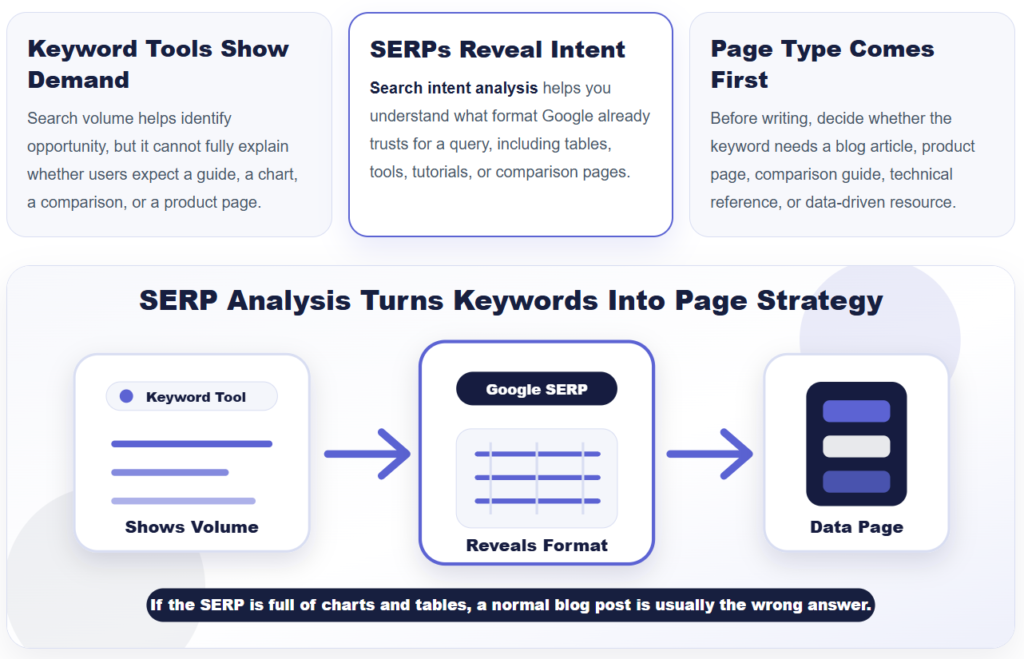
Many SEO teams still make the same mistake: they check a keyword tool, see search volume, and immediately start writing. But a keyword tool only tells you that people search for something. It does not tell you what type of page Google believes should answer that query.
That is why the next step was Google SERP analysis. For every important keyword group, we opened Google and studied the first page results. We looked at whether the ranking pages were blog posts, product pages, comparison guides, data tables, calculators, category pages, or technical references.
A good example is NiMH voltage chart. When Google shows pages full of charts, tables, voltage data, and discharge curves, the message is clear: users are not looking for a casual blog post. They want a structured data page that helps them quickly understand voltage behavior.
Group Keywords by Intent and Semantic Relationship
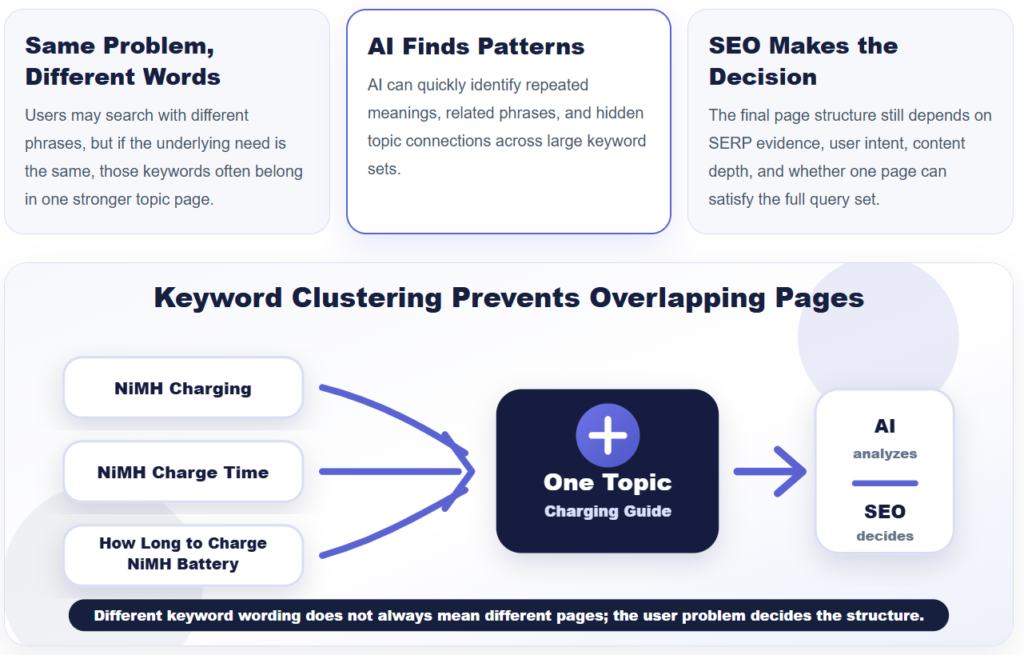
After collecting keywords and reviewing the SERPs, the next step was keyword clustering. This is where many content strategies either become organized or fall apart. If every keyword becomes a separate page, the site can quickly turn into a collection of thin, overlapping articles.
For example, NiMH charging, NiMH charge time, and how long to charge NiMH battery should not automatically become three separate pages. These searches are different expressions of one broader user problem: how to charge correctly, safely, and efficiently.
This is where AI became useful as an analysis assistant. AI helped us discover semantic relationships between keywords, while the SEO team made the final decision based on search intent, SERP format, user journey, and product knowledge. In simple terms, AI helped analyze; SEO had to judge.
Build a Pyramid Topic Structure Instead of Random Pages
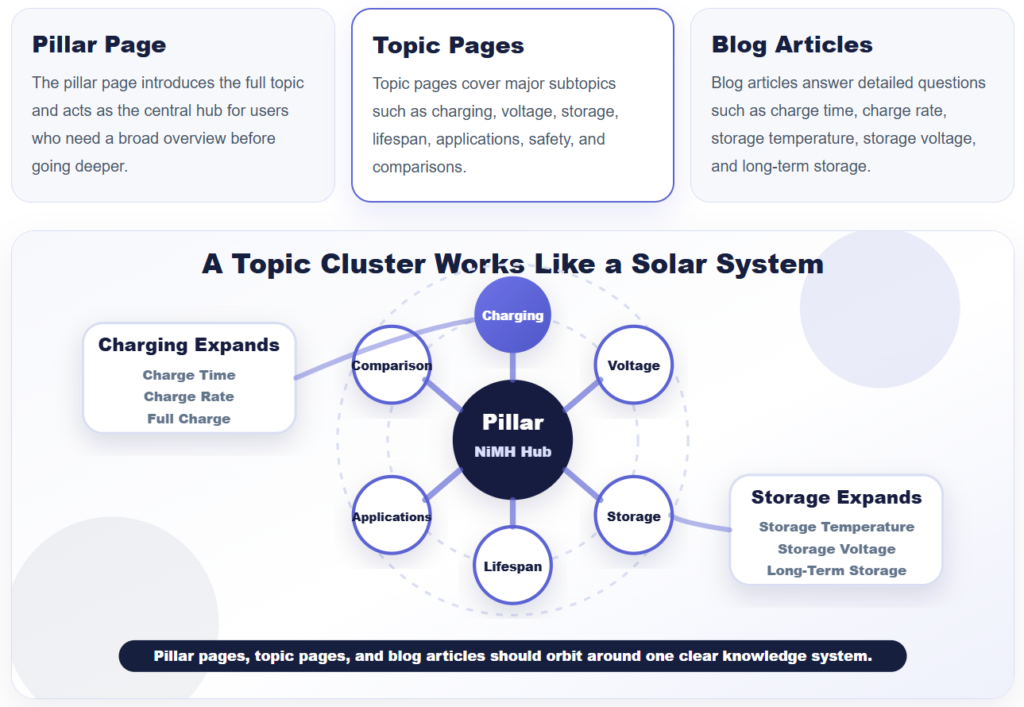
Once the keywords were grouped, the next step was building a pyramid topic structure. This is where the content system started to look less like a blog archive and more like a structured knowledge hub. A strong topic cluster should make it clear which page is the parent, which pages are supporting topics, and which articles answer detailed questions.
For the NiMH project, the main pillar page became the center. Around it, we planned major supporting topics such as Charging, Voltage, Lifespan, Storage, Applications, Safety, and Comparison. Each of these could then expand into more specific pages or blog articles.
A useful way to think about this is the solar system model: the pillar page is the sun, topic pages are planets, and supporting blog articles are moons. This makes the structure easier for users to navigate and easier for search engines and AI systems to understand.
Expand Each Topic With Google, Reddit, and Quora
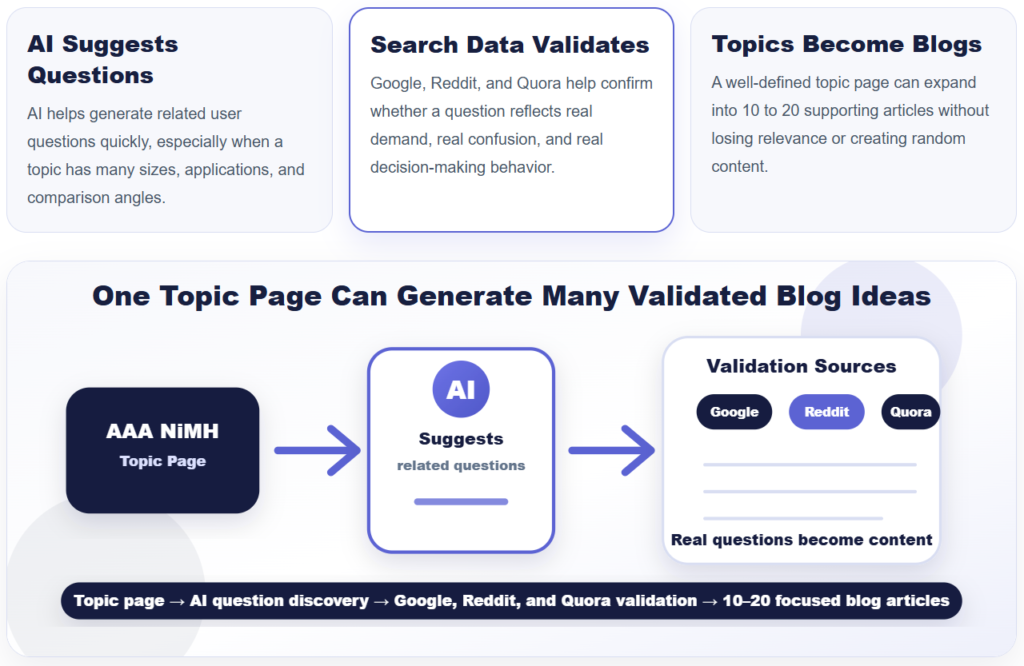
After the main topic structure was built, AI became more useful for expansion. At this stage, the goal was not to let AI invent content ideas. The goal was to use AI to suggest possible user questions, then validate those questions through real search behavior and community discussions.
For example, when we analyzed AAA NiMH Battery, AI helped surface related long-tail questions such as highest capacity AAA NiMH, AAA NiMH for solar lights, AAA NiMH for TV remote, and AAA NiMH for cordless phone.
But AI suggestions were only the starting point. We then checked Google search results, Reddit discussions, and Quora questions to see whether real users were actually asking those questions. This helped turn one topic page into a focused group of 10 to 20 supporting blog articles.
Build Parent-Child Internal Links Into a Knowledge Network
Many websites publish a large number of pages, but those pages often stand alone. They may cover related subjects, yet users and search engines cannot clearly understand how one page connects to another. That is why internal linking should not be treated as an afterthought.
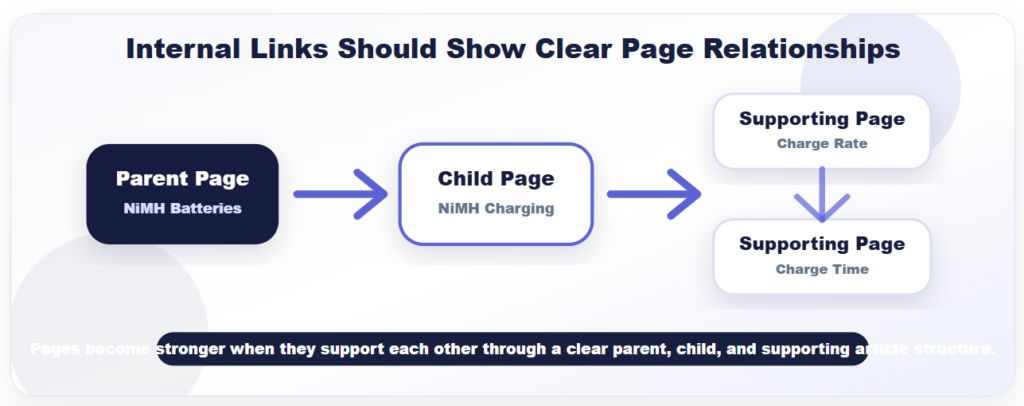
In this project, we used a parent-child structure. A parent page introduced the broader topic, child pages covered major subtopics, and supporting articles answered narrower questions. For example, the path could move from NiMH Batteries to NiMH charging, then to charge rate, and finally to charge time.
This type of topic cluster structure helps users go deeper step by step. It also helps search engines and AI systems understand that the site is not publishing random articles, but building a connected knowledge network around one focused subject.
What Happened After Two Months and Twenty Days
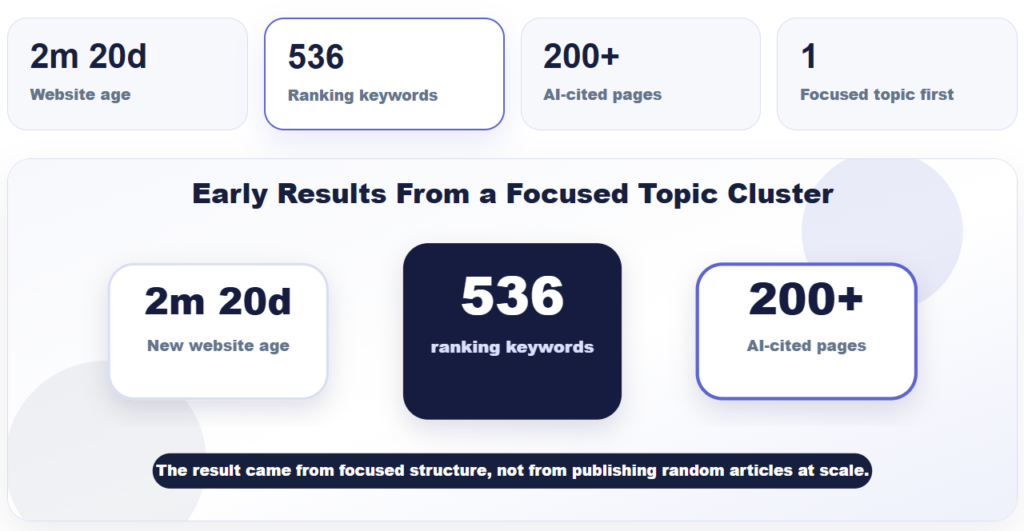
The goal of this case study is not to make exaggerated claims. The website is still young, and the project is still developing. But after two months and twenty days, the early data showed that the structured approach was working.
With the site focused on one core topic first, the NiMH topic cluster began ranking for 536 keywords, and more than 200 pages appeared in AI-cited search experiences. For a new manufacturing website, this suggested that a focused knowledge hub could build visibility faster than publishing disconnected product and blog pages.
AI Did Not Change the Core Logic of SEO
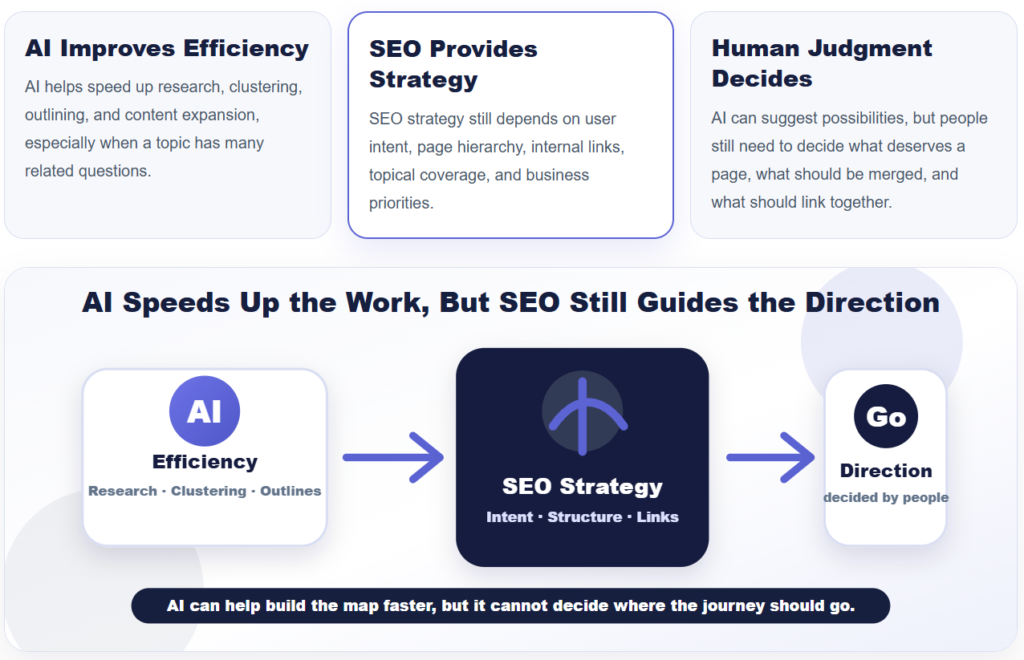
The most important lesson from this project is simple: AI did not replace the fundamentals of SEO. It made the workflow faster, but it did not change what actually matters. A strong content system still depends on keyword research, search intent analysis, content architecture, user demand, internal linking, and real industry knowledge.
AI can help you collect ideas, organize keyword groups, compare semantic relationships, and outline possible content paths. But it cannot decide which market you should focus on first, which page should become the pillar page, or how users should move through your site. Those decisions still require human judgment.
In other words, AI can help you build the map faster, but it cannot decide where the journey should go. The strategy still comes from understanding your users, your products, your search landscape, and the business goal behind the content.
Want to Study a Real Topic Cluster Example?
If you want to study how a traditional manufacturing website can use a structured topic cluster to build industry authority, you can review the NiMH knowledge hub we built as a real-world example.
The page below is not just a product page. It acts as the central pillar for a growing content system covering charging, voltage, lifespan, storage, applications, comparisons, and related educational content.
Real-World Topic Cluster Reference: NiMH Batteries
Use this page as a reference to see how one focused topic can become the foundation for a broader knowledge network.
Frequently Asked Questions
No. AI improves efficiency, but successful SEO still depends on keyword research, search intent analysis, content architecture, internal linking, user demand, and industry expertise.
Focusing on one topic cluster first helps a new website build clearer topical authority. It is usually more effective than publishing many disconnected articles across unrelated categories.
AI helped identify semantic keyword relationships, discover supporting content ideas, organize topic groups, and speed up research. Final decisions were still based on SERP analysis and human SEO judgment.
Google SERP analysis helps determine search intent and page type. It shows whether users expect a blog post, product page, comparison guide, data table, chart, or technical reference.
A strong topic page can often support 10 to 20 related blog articles, depending on user questions, search demand, application scenarios, comparison intent, and technical subtopics.
Internal linking helps users and search engines understand how pages relate to each other. A clear parent-child structure can turn isolated pages into a connected knowledge network.
Yes. A structured topic cluster makes it easier for search engines and AI systems to understand entities, relationships, topical coverage, and the depth of information on a website.
The biggest mistake is starting with AI-generated content before building the strategy. AI should support keyword discovery, clustering, SERP analysis, and content planning before writing begins.