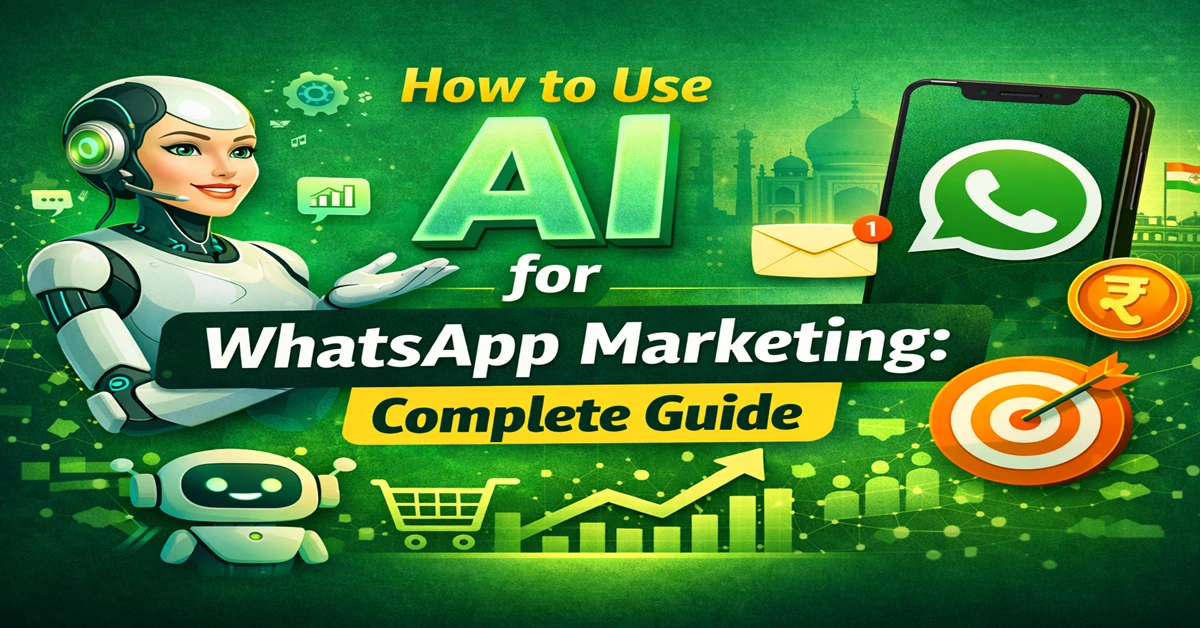
AI for WhatsApp Marketing is transforming how Indian businesses connect with their customers, and the numbers make it impossible to ignore.
Think about the last time you ignored a WhatsApp message. It is hard to remember, right? That is exactly the point.
India has 535 million active WhatsApp users. It is not just the largest WhatsApp market in the world. It is the single most important place your customers already spend a chunk of their day. They share memes here. They talk to their families here. And increasingly, they are buying things here too.
Here is what is frustrating though. Most Indian small businesses are still using WhatsApp the same way they were in 2018. Manually copying and pasting replies. Sending the same message fifty times a day. Missing leads that came in at midnight because nobody was awake to respond.
That is where AI comes in. In 2026, Indian businesses that have combined WhatsApp with AI automation are doing something genuinely remarkable. They are qualifying leads while the team sleeps. They are recovering abandoned carts within fifteen minutes. They are completing sales inside a chat window, with a UPI payment at the end, without the customer ever opening a website.
Why WhatsApp and AI Is the Biggest Marketing Opportunity in India Right Now
Before we get into the how, it helps to understand the scale we are working with. These numbers explain why smart Indian marketers are going all in on WhatsApp.
| 535M | Active WhatsApp users in India, the largest user base of any country in the world |
| 70% | Average read rate for WhatsApp broadcasts in India, compared to just 2 to 5% for email |
| 66% | WhatsApp business conversations that end in a completed purchase |
| 80% | Repetitive customer queries that AI-driven WhatsApp automation can now handle without human help |
Those numbers are hard to ignore. But what really makes 2026 different from previous years is the arrival of proper conversational commerce in India. Customers can now discover your product, ask questions, get personalised recommendations, and pay via UPI, all without ever leaving a WhatsApp chat. For a mobile-first market like India, that removes every single friction point in the buying journey.
The other big shift is in affordability. You no longer need a developer or a large team to set this up. Indian-built tools have made it genuinely accessible. If you have not already built out your digital marketing strategy, it is worth reading this guide on creating a digital marketing strategy for Indian businesses before diving into WhatsApp specifically. A WhatsApp AI setup works much better when it fits into a broader plan.
WhatsApp Business App vs WhatsApp Business API: Which One Do You Actually Need?
This is the question that trips up most Indian business owners early on, and it is worth spending a moment on before anything else.
| Feature | WhatsApp Business App | WhatsApp Business API |
| Best suited for | Solo freelancers and very small shops | SMBs, startups, D2C brands |
| Sending messages | Manual only | Automated, bulk, and scheduled |
| AI chatbots | Not supported | Fully supported |
| Broadcast limit | 256 contacts per list | Unlimited with opt-in consent |
| Multi-agent inbox | Not available | Whole team in one shared inbox |
| CRM integration | Not available | Yes, Zoho, HubSpot, Leadsquared |
| UPI in-chat payments | Not available | Supported |
| Cost | Free | BSP plan plus Meta conversation fees |
| Important note: Only use the official WhatsApp Business API through an approved BSP (Business Solution Provider). Unofficial bulk WhatsApp tools risk a permanent ban on your number and can put you in violation of India’s DPDP Act. The official API is the only safe and scalable path. |
Five Ways AI Is Actually Changing WhatsApp Marketing for Indian Businesses
This is where it gets practical. Here are the five real-world applications that Indian businesses are using right now.
1. AI chatbots that qualify leads around the clock
WhatsApp AI chatbots generate up to five times more leads than traditional marketing channels, with an average lead conversion rate of 28%. On top of that, 67% of WhatsApp users already trust chatbot support on the platform.
Think about what that means for a coaching institute in Jaipur that gets two hundred enquiries a day from Instagram and Google Ads. Without automation, most of those leads go cold by the next morning. With an AI chatbot, every single enquiry gets an instant response, gets asked the right qualifying questions, and gets tagged in the CRM before the team even wakes up.
2. Personalisation that feels like a human wrote it
WhatsApp personalisation increases brand engagement for 72% of users who receive tailored messages. AI tools in 2026 pull from your CRM data to craft messages that feel genuinely personal. Not just inserting a first name, but referencing what someone bought, when they last ordered, and what they are likely to want next.
A good example: a D2C skincare brand in Mumbai can trigger an automatic WhatsApp message thirty days after a purchase that says something like “Hey Priya, your Vitamin C serum is probably running low by now. Want to grab another bottle before we run out of stock?” No manual work. No generic blast. Just a message that feels like it came from someone who actually knows the customer.
3. Regional language messaging at scale
73% of Indian internet users prefer content in their regional language. And yet most small businesses default to English for all their WhatsApp marketing, which means they are invisible to a huge portion of potential customers in tier-2 and tier-3 cities.
AI translation and multilingual NLP tools now let you run a single WhatsApp campaign simultaneously in Hindi, Tamil, Telugu, Marathi, and Bengali from one dashboard. A brand expanding from metros into smaller cities does not need five separate teams anymore. One well-structured AI setup handles the complexity automatically.
4. Conversational commerce with UPI built right in
In 2026, WhatsApp is functioning as a full conversational commerce platform for many Indian businesses. A customer sees your Instagram ad, taps through to WhatsApp, chats with your AI bot, picks their product variant, and pays via UPI. The whole thing happens in one window without ever visiting your website.
For Indian D2C brands, this is significant because cart abandonment rates for WhatsApp-initiated purchases are much lower than website-initiated ones. The convenience factor is doing a lot of the heavy lifting.
5. RTO reduction for COD orders (a uniquely Indian problem)
This is one use case that international WhatsApp guides never mention, but it is hugely relevant in India. A significant percentage of cash-on-delivery orders are never accepted at the door, which costs D2C brands enormously in logistics fees and wasted inventory.
AI-powered WhatsApp automation tackles this by sending an order confirmation message immediately after a COD purchase, verifying the delivery address, and offering a small discount to switch from COD to prepaid. Brands using this flow are seeing RTO reductions of 20 to 40%. That kind of saving adds up fast.
The Best AI for WhatsApp Marketing Tools for Indian Businesses in 2026
All five tools below are official WhatsApp Business Solution Providers, which means they are fully compliant with both WhatsApp policy and India’s DPDP Act.
| Tool | Best For | Starting Price | AI Chatbot | Hindi Support | UPI Payments |
| Wati | SMBs across most sectors | ₹2,499/month | Yes | Yes | Yes |
| AiSensy | D2C brands and e-commerce | ₹999/month | Yes | Yes | Yes |
| Interakt | Startups on a tighter budget | ₹999/month | Yes | Yes | Yes |
| Gupshup | Enterprise and dev teams | Custom pricing | Advanced NLP | Yes | Yes |
| DoubleTick | Sales-focused teams | ₹2,000/month | Yes | Yes | No |
Our recommendation for most Indian small businesses: start with Interakt or AiSensy. Both are built in India, support Hindi and other regional languages, integrate with Shopify and WooCommerce, and have customer support teams available during Indian business hours. When you are ready for more advanced automation, Wati is the natural next step.
Step by Step: How to Set Up AI for WhatsApp Marketing for Your Business
Follow these eight steps in order to setup AI for WhatsApp Marketing. Do not skip step three. It is the most legally important one.
- Sign up with a BSP: Register with Wati, Interakt, or AiSensy. They will guide you through the WhatsApp Business API application. For most Indian businesses, approval takes between two and five business days.
- Verify your Facebook Business Manager: You will need a verified Meta Business Manager account linked to your business. Keep your GST certificate or business registration document ready for the verification step.
- Build your opt-in list the right way: Under India’s DPDP Act (2023), you cannot legally send marketing messages without explicit consent from the recipient. Add WhatsApp opt-in checkboxes to your website contact forms, landing pages, and Instagram bio. Never import a purchased contact list.
- Build your first AI chatbot: Start simple. Pick your ten most common customer questions and map out the answers. All the BSPs listed above have no-code drag-and-drop chatbot builders. Most business owners can get a working FAQ and lead qualification bot live within a couple of hours, no coding required.
- Run your first broadcast campaign: Segment your opted-in contacts by city, language preference, or past purchase behaviour. Keep the first broadcast short and conversational. Track your read rate closely. A good benchmark is 65% or above.
- Set up your key automation flows: The four flows worth setting up first: a welcome message for new opt-ins, a cart abandonment recovery message at fifteen to twenty minutes after abandonment, a COD order confirmation and address verification message, and a reorder nudge at thirty days after the last purchase.
- Connect WhatsApp to your CRM: Sync your WhatsApp conversations with Zoho, HubSpot, or Leadsquared. This means your sales team can see the full history of every conversation before they pick up the phone. It makes a noticeable difference in conversion rates.
- Track your performance every week: The numbers that matter: read rate (target 65% or above), reply rate (target 20 to 35% for broadcasts), chatbot deflection rate (target 70% or above), and cost per conversation.
WhatsApp AI Marketing Playbooks by Industry: Real Indian Business Examples
E-commerce and D2C brands
Use your AI chatbot for product discovery, size and variant questions, and order tracking. Set up cart recovery at fifteen minutes and again at two hours after abandonment. Build a COD verification flow to reduce RTO. Run personalised reorder campaigns at twenty-five and forty-five days after the last purchase. Brands who have this setup running properly are typically seeing cart recovery rates between 15 and 25%, and RTO reductions of 20 to 40%.
EdTech and coaching institutes
Your AI chatbot should be qualifying every inbound enquiry automatically. Ask about which course they are interested in, their budget, their city, and their preferred schedule. Send the relevant brochure and a free demo class link automatically. Then set up a follow-up sequence at day one, day three, and day seven after the initial enquiry. This one setup alone can replace several hours of manual work daily for a mid-sized coaching institute.
Real estate
Ask your chatbot to collect budget range, BHK requirement, preferred location, and possession timeline at the start of every conversation. Tag the lead automatically and notify the right agent. Send three matching property listings with photos directly into the chat. Then set up an automatic follow-up if there is no response within forty-eight hours. For Indian real estate agents handling tier-2 city leads, this kind of automation is a genuine game-changer.
Local retail and kirana stores
Entry-level BSP plans start from as little as ₹500 to ₹999 per month. For a local retailer, a simple chatbot can handle stock enquiries, send daily deal broadcasts to opted-in customers, and keep a basic loyalty programme running. Setup time is typically under a day. No technical knowledge needed.
Healthcare and wellness
Appointment reminders sent via WhatsApp reduce no-shows by 30 to 40% at most clinics that have tried it. Add prescription refill nudges at twenty-five days, lab report delivery over WhatsApp, and post-treatment follow-up messages at day three and day seven. An AI triage chatbot that collects symptoms and basic details before connecting to a doctor also saves significant consultation time.
What Not to Do: The Mistakes That Can Get Your Number Banned
These are the mistakes we see Indian businesses make most often. All of them are avoidable.
- Using unofficial bulk WhatsApp senders: These are cheap but they carry a very real risk of getting your number permanently banned. It is not worth it.
- Sending without opt-in consent: This violates both WhatsApp’s own policy and India’s DPDP Act. If you are caught doing this, you lose your number and potentially face regulatory consequences.
- Sending too many broadcasts: More than two or three per week is generally where block rates start to climb. WhatsApp marketing in 2026 works because it feels personal and timely. The moment it feels like spam, people block you and your quality rating drops.
- Defaulting to English only: A Hindi or Tamil message to a non-metro customer will almost always outperform an English one. Most brands still make this mistake.
- Not connecting WhatsApp to your CRM: When a sales person calls a lead with zero context about the WhatsApp conversation that already happened, it destroys the experience immediately.
- Building a chatbot and never updating it: An outdated chatbot giving wrong prices or mentioning discontinued products is worse than no chatbot. Set a reminder to review it monthly.
How to Measure Whether Your AI for WhatsApp Marketing Is Actually Working
Most Indian businesses track only read rate. That tells you one thing. Here are the five metrics that together give you the full picture.
| Metric | What It Tells You | Target | How to Improve |
| Read rate | Percentage of messages opened | 65% or above | Better timing, personalised opening line |
| Reply rate | Percentage who respond to your broadcast | 20 to 35% | Clear call to action, use buttons and carousels |
| Chatbot deflection | Queries resolved without a human agent | 70% or above | Expand FAQ coverage, review unresolved logs monthly |
| Cart recovery rate | Abandoned carts that result in a purchase | 15 to 25% | Faster trigger time, add social proof in message |
| Cost per conversation | What you pay Meta per 24-hour window | Track monthly | Better audience segmentation to reduce wasted sends |
For tracking without spending anything extra: check your BSP dashboard every week for read and reply rates. Set up UTM parameters on every WhatsApp link so Google Analytics 4 can show you how much website traffic is coming from your WhatsApp activity. And read through your chatbot’s unresolved query log every month. Every unanswered question in that log is something to fix.
Final Thoughts: This Is More Achievable Than It Sounds
66% of WhatsApp business conversations end in a completed purchase. No other marketing channel in India comes close to that number.
The combination of AI automation, regional language support, personalised messaging, and in-chat UPI payments has made WhatsApp the most powerful direct marketing channel available to Indian businesses in 2026. And unlike paid advertising, where every rupee you stop spending means your visibility disappears, the systems you build on WhatsApp compound over time.
The good news is that the setup is a lot more approachable than it might seem right now. Pick a BSP, build a five-question FAQ chatbot this week, and see how your customers respond. Most businesses are surprised by how quickly they start seeing results. Then add one automation flow. Then another. You do not have to do everything at once.
This step-by-step guide to building a digital marketing strategy on Blog Arena 360 before you start setting things up. Getting your strategy right makes every channel, including WhatsApp, perform significantly better.
Blog Arena 360 welcomes guest contributors in the digital marketing and AI space. Publishing your expertise is one of the best ways to build your authority and grow your own audience at the same time.
FAQs:
Yes, absolutely, as long as you do it through the official WhatsApp Business API and collect proper opt-in consent from your customers before sending them marketing messages. India’s DPDP Act (2023) requires explicit consent for marketing communications. If you follow the setup process described in this guide, you are fully compliant.
The WhatsApp Business API is the official platform that allows businesses to send automated, bulk, and AI-powered messages. In India, you access it through an approved BSP partner like Wati, Interakt, AiSensy, or Gupshup. You cannot apply directly through Meta. Your BSP handles the application and approval process on your behalf.
BSP plans start from around Rs 999 to Rs 2,499 per month. On top of that, Meta charges per conversation window, which is currently around Rs 0.97 per marketing conversation (a 24-hour window). For a business sending around 10,000 marketing messages a month, the total cost including the BSP plan typically lands between Rs 12,000 and Rs 20,000 per month.
The standard WhatsApp Business App is free and works well for very small businesses seeing fewer than fifteen to twenty customers per day. For AI automation, bulk broadcasting, and chatbots, you need the API, which comes with costs. Some BSPs do offer a limited free tier covering up to 1,000 conversations per month, which is a good way to test the setup before committing to a paid plan.
For most Indian small businesses, Interakt and AiSensy are the strongest options when you weigh price, features, and support. Both are built in India, support regional languages including Hindi, integrate with popular Indian e-commerce platforms, and have local support teams you can actually reach during the day.
Tools like Wati, Interakt, and DoubleTick all have no-code drag-and-drop chatbot builders. The practical starting point is to write down your ten most frequently asked questions and build a flow that answers each one. Most business owners who have never touched a chatbot before can get a working version live within two to three hours using these tools.
It often works better in non-metro cities than in metros. WhatsApp penetration is extremely high in smaller cities, customer trust in WhatsApp-based communication tends to be strong, and the competition from other businesses using AI automation is much lower. Adding regional language support, Hindi in particular, makes a significant difference in engagement rates in these markets.