
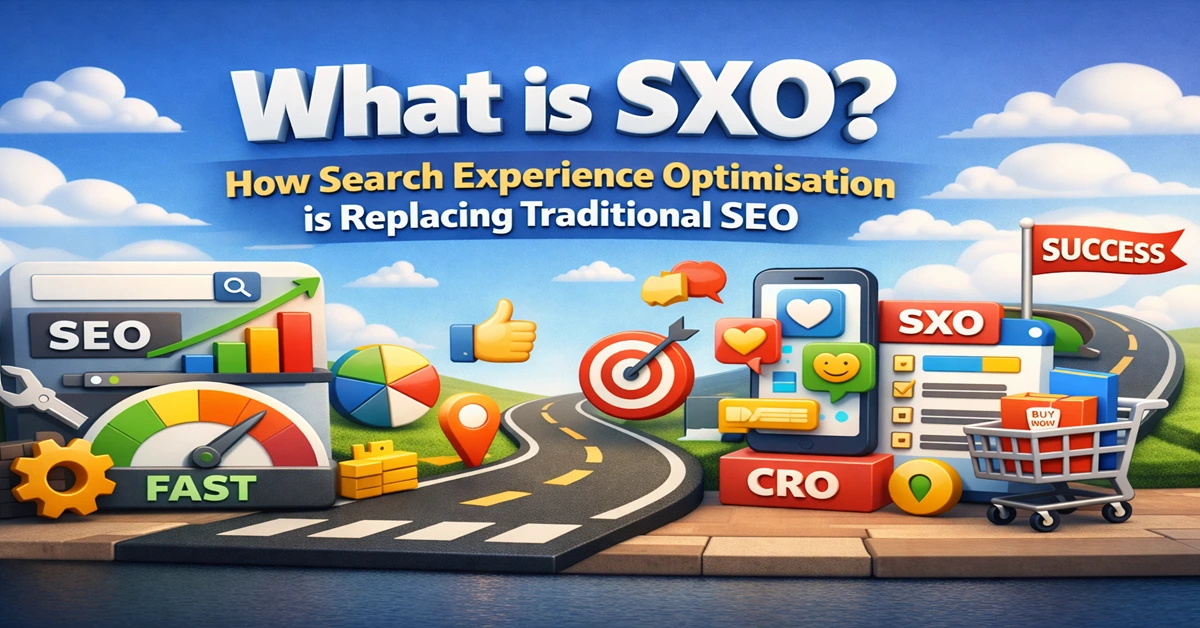
What is SXO? It is the question reshaping how smart marketers think about organic search in 2026. According to Semrush’s 2025 zero-click study, 58.5% of all U.S. searches and 59.7% of EU searches now end without a single click to any website. In Q1 2026, that figure has climbed to 65%. The equation that powered a decade of SEO strategy, rank higher to get more traffic, has broken down.
Yet businesses that understand search experience optimisation (SXO) are not panicking. They are converting. Because the question in 2026 is no longer simply how to rank. It is how to be visible, trusted, and chosen across every stage of the search journey.
This guide explains what SXO is, how it differs from traditional SEO, why Google now rewards it, and how to start applying it to your own website. Whether you are a marketing professional or a business owner building your first search strategy, this is the definitive starting point.
| Key stat: Gartner projects a 25% decline in traditional search traffic by end of 2026. The businesses that adapt to SXO now will capture the traffic that unprepared competitors lose. |
1. What is SXO? A clear definition
SXO, or search experience optimisation, is the practice of optimising both search engine visibility and on-site user experience simultaneously. It combines three disciplines into one connected strategy: SEO (search engine optimisation), UX (user experience design), and CRO (conversion rate optimisation).
| The SXO formula: SXO = SEO + UX + CRO |
Where traditional SEO stops at earning the click, SXO asks what happens after the click. Does the page load fast enough? Does the content answer what the user actually wanted? Is there a clear path to the next action? These questions, once considered the domain of web designers and UX teams, are now central to how Google ranks content.
The term has gained significant traction as Google’s algorithm has shifted toward measuring user behaviour signals (dwell time, scroll depth, pogo-sticking rate, engagement rate) as ranking factors. A page that ranks well but delivers a poor experience will progressively lose ground to a page that ranks slightly lower but keeps users engaged.
1.1 Where SEO ends and SXO begins
The clearest way to understand SXO is to identify where traditional SEO’s scope stops. SEO is concerned with: keyword research, on-page optimisation, technical site health, backlink authority, and SERP feature targeting. These are the inputs that earn visibility.
SXO adds the output layer. It asks: once the user sees your listing and clicks, do they get what they came for? Do they stay, scroll, and convert? Or do they bounce back to Google and click a competitor instead? That bounce signal (called pogo-sticking) is now a negative ranking factor. SXO is the strategy that eliminates it.
1.2 Why the word ‘experience’ changes everything
The shift from SEO to SXO is not cosmetic. It reflects a fundamental change in what search engines measure. Google’s 2025 ranking system updates explicitly incorporated user experience signals as primary ranking inputs, not secondary ones. When a user lands on your page and immediately returns to Google, that behaviour tells the algorithm your page did not satisfy their intent. Enough of those signals and rankings drop, regardless of how strong the technical SEO foundation is.
This is why understanding how AI is changing SEO is essential context for any SXO strategy. AI-driven ranking systems are better than ever at interpreting user satisfaction signals, which means the gap between a good SEO strategy and a great SXO strategy is becoming the gap between stagnation and compounding growth.
| SECTION 2 |
2. The three pillars of SXO
SXO rests on three interconnected pillars. Each one is necessary. None is sufficient on its own. The competitive advantage comes from running all three as a unified system rather than separate workstreams.
2.1 Pillar 1: SEO (the visibility foundation)
Without search visibility there is no user experience to optimise. SEO remains the essential foundation of any SXO strategy, covering:
- Keyword research and semantic topic clustering to ensure every page targets real user intent
- Technical site health: crawlability, indexation, structured data markup, and XML sitemaps
- E-E-A-T signals: demonstrating Experience, Expertise, Authoritativeness, and Trustworthiness through content quality and author credentials
- SERP feature targeting: featured snippets, People Also Ask boxes, AI Overviews, and rich results
Stat: results on page two of Google receive less than 1% of all user clicks. Visibility is the non-negotiable first requirement of any SXO strategy.
2.2 Pillar 2: UX (the on-page experience)
Once the user clicks, UX determines whether they stay or immediately leave. Google’s Core Web Vitals are the technical expression of this pillar, measuring three critical dimensions of page experience:
Largest Contentful Paint (LCP)
LCP measures how fast the main content of a page loads. The target is under 2.5 seconds. Google data shows a 24% bounce rate increase when LCP exceeds 2.5 seconds, meaning slow pages directly damage both UX and rankings.
Interaction to Next Paint (INP)
INP replaced First Input Delay as Google’s core responsiveness metric in 2024. It measures how quickly a page responds to user interactions (clicks, taps, keyboard inputs). Target: under 200 milliseconds. A sluggish interface tells users the site is unreliable and creates the friction that triggers bounces.
Cumulative Layout Shift (CLS)
CLS measures visual stability: how much the page layout shifts as it loads. Unexpected layout shifts (caused by late-loading images, ads, or fonts) are among the most frustrating UX experiences and penalised by Google. Target: under 0.1.
Beyond Core Web Vitals, the UX pillar covers mobile-first design, intuitive navigation architecture, above-the-fold clarity (the first 600px of any page should communicate what the page is, who it is for, and what to do next), and accessible design for all users.
2.3 Pillar 3: CRO (the conversion layer)
CRO is the bridge between a great user experience and a measurable business outcome. It ensures that users who arrive and stay are guided clearly toward the action that matters: a sign-up, a purchase, an enquiry, or a content download.
Intent-matched CTAs
A call to action must match the intent stage of the user. A visitor arriving from an informational query (“what is SXO”) needs an educational next step, not an immediate sales pitch. Mismatched CTAs are one of the leading causes of high engagement with low conversion.
Above-the-fold conversion signals
The most impactful CRO improvement on any page is ensuring the first visible screen communicates a clear value proposition, a single primary CTA, and a trust signal (a testimonial, a statistic, or a recognisable brand element). Users who do not see a reason to stay in the first 10 seconds rarely create a reason to return.
A/B testing and scroll optimisation
Systematic A/B testing of CTA placement, headline phrasing, and button design removes guesswork from conversion optimisation. SXO-optimised sites with intent-matched CRO strategies generate 200-400% more conversions than classic SEO-only approaches on the same traffic volume, which makes CRO the highest-leverage pillar for sites with established organic traffic.
3. SXO vs SEO: what is the real difference?
The most searched question in this space is how SXO and SEO differ. The answer is that they are not competitors. SEO is one pillar of SXO. The distinction is in scope, measurement, and mindset.
| Traditional SEO | SXO | |
| Goal | Earn search rankings | Earn rankings AND convert visitors |
| Success metric | Keywords ranked, organic traffic | Engagement rate, dwell time, conversion rate |
| Optimises for | Search engine algorithms | Algorithms + real human behaviour post-click |
| Where it ends | At the click | At the completed user goal |
| Core tools | Semrush, Ahrefs, GSC | Semrush + Clarity + GA4 + Hotjar + VWO |
| Time horizon | 3-6 months for ranking impact | Conversion impact visible within weeks |
| Measures | Page 1 rankings, impressions, CTR | Scroll depth, session duration, task completion |
The ecommerce proof point makes this concrete. An SXO-optimised site with 50,000 monthly visitors and a 2% conversion rate generates 1,000 customers. A traditional SEO site with 100,000 visitors but a 0.5% conversion rate generates just 500. SXO doubles the output at half the traffic volume. This is why CRO layered on top of SEO is not optional for competitive businesses in 2026.
4. Why Google now rewards SXO over traditional SEO
Google’s algorithm evolution over the last three years has consistently moved in one direction: toward measuring what users actually do, not just what pages say. This shift is the structural reason SXO is no longer optional for competitive organic search performance.
4.1 Behavioural signals as ranking factors
Google’s machine learning-based ranking systems now incorporate behavioural signals as primary inputs. Dwell time, scroll depth, pogo-sticking rate (returning to Google immediately after a click), and engagement rate (the GA4 replacement for bounce rate) all feed into the algorithm’s assessment of page quality.
The practical implication: a page that ranks for a keyword but delivers a poor experience will gradually lose ground to a page that delivers clear, fast, intent-matched content, even if the latter has fewer backlinks.
4.2 The zero-click reality and what it means
The zero-click environment is the defining context for SXO in 2026. For searches triggering AI Overviews, the median zero-click rate has reached 83%, averaging 80-83% across AIO-triggered queries. Traditional queries without AI Overviews hover near 60%.
Mobile users are 66% more likely to experience zero-click searches than desktop users, and mobile now accounts for over 63% of all Google queries. This means the majority of search interactions happen on devices where zero-click behaviour is already dominant.
This does not mean SEO is dead. It means that the value of appearing in search has shifted from click volume to brand visibility, authority signals, and SERP feature presence. SXO captures value across all of these dimensions, not just the traditional blue-link click.
4.3 AI Overviews and the citation opportunity
44.2% of all LLM citations come from the first 30% of a text (the introduction). This means SXO-optimised pages that answer the search query clearly and immediately in their opening section are not just better for users; they are significantly more likely to be cited by Google AI Overviews, Perplexity, and ChatGPT Search than pages that bury the answer.
For a deeper understanding of this shift, the guide to GEO (generative engine optimisation) explains exactly how to optimise for AI-generated search results alongside traditional rankings.
5. SXO and GEO: optimising for the full 2026 search landscape
SXO is the strategy for what happens after the click. GEO (generative engine optimisation) is the strategy for appearing in AI-generated answers before the click. In 2026, you need both.
5.1 What GEO is and why it matters alongside SXO
GEO is the practice of optimising content so that AI platforms (Google AI Overviews, Perplexity, ChatGPT Search, Gemini) can understand, cite, and surface your content in their generated answers. The full GEO framework is covered in detail here, but the core principle is this: if you are not being cited by AI tools, you are invisible to a growing share of high-intent users who never reach a traditional SERP at all.
Traffic from AI platforms increased 527% year over year according to AllAboutAI’s 2025 data. That growth trajectory makes GEO one of the most important emerging channels in any search visibility strategy.
5.2 How SXO, GEO, and AEO work together
The complete 2026 search visibility framework combines three disciplines. SXO optimises the on-site experience after the click. GEO optimises for citation in AI-generated summaries. AEO (answer engine optimisation) optimises for direct-answer placements in voice search, featured snippets, and People Also Ask boxes. A full guide to AEO is available here.
These three disciplines are not competing frameworks. They are sequential layers of the same strategy: earn visibility (SXO + SEO), earn AI citations (GEO), earn direct answer placements (AEO). Brands that integrate all three are building a search presence that is resilient to any single algorithm change.
5.3 Practical GEO tactics that support SXO
- Write clear Q&A format content with answers in the first 300 words of each section to maximise AI Overview eligibility
- Use structured data markup (FAQ schema, HowTo schema, Article schema) to help AI systems interpret your content accurately
- Optimise entity signals by ensuring your brand, authors, and key topics are well-defined and consistently referenced across your site
- Cite credible external data sources (as this article does) to build the trust signals that AI systems weight heavily when selecting content to cite
6. How to start applying SXO: a practical 5-step framework
Understanding SXO is one thing. Implementing it is another. The five steps below are sequenced deliberately: each one builds the foundation for the next. Work through them in order for the fastest measurable impact.
6.1 Step 1: audit your current search experience
Before optimising anything, establish a baseline across all three SXO pillars. Three tools cover this:
- Google Search Console: identifies which queries drive impressions vs clicks, revealing intent gaps between what you rank for and what you deliver
- Google PageSpeed Insights: diagnoses Core Web Vitals performance with specific recommendations for LCP, INP, and CLS improvements
- Microsoft Clarity (free): provides heatmaps, session recordings, rage click analysis, and scroll depth data showing exactly where users stop engaging and why
6.2 Step 2: map search intent to every key page
Every page on your site serves one of four intent types: informational (learning), navigational (finding a specific site or page), commercial (comparing options before a decision), or transactional (ready to act). Mismatching content to intent is the single most common cause of high traffic with low conversion.
Audit your ten highest-traffic pages. Identify what intent category each serves. Then check whether the content, CTA, and conversion path match that intent explicitly. Informational pages should lead to the next educational resource. Transactional pages should lead to the conversion action with as few intermediate steps as possible.
6.3 Step 3: fix Core Web Vitals
Core Web Vitals are the most directly actionable UX improvement with a measurable ranking impact. Priority fixes in order of typical impact:
- LCP: compress and properly size images, eliminate render-blocking resources, implement lazy loading for off-screen content
- INP: defer non-critical JavaScript, minimise main thread work, optimise event handlers on interactive elements
- CLS: set explicit width and height attributes on all images and video elements, avoid inserting content above existing content after page load
6.4 Step 4: optimise above-the-fold for conversion
The first 600 pixels of any page are the most valuable real estate in SXO. Users decide whether to stay or leave within 10 seconds of landing. Your above-the-fold content must communicate three things immediately: what this page is, who it is for, and what to do next.
Place your primary CTA above the fold on all commercial and transactional pages. Write your value proposition as a headline, not a paragraph. Include one trust signal (a testimonial, a data point, or a recognisable client logo) within the first screen. Remove any navigation elements, pop-ups, or modal triggers that interrupt this clarity.
6.5 Step 5: track SXO metrics, not just SEO metrics
Traditional SEO dashboards track rankings, impressions, and clicks. SXO requires a broader measurement set. Configure these five metrics in Google Analytics 4 as your core SXO performance indicators:
- Engagement rate (the GA4 replacement for bounce rate): sessions lasting more than 10 seconds, involving a conversion event, or including two or more page views
- Average session duration: how long users spend on your site after arriving from search
- Scroll depth: what percentage of a page users typically reach before leaving (under 50% scroll depth on a content page signals an intent mismatch)
- CTA click rate: the percentage of visitors who interact with your primary conversion element
- Conversion rate by traffic source: organic search visitors who convert, broken down by landing page and keyword intent category
7. The SXO tool stack: What to use for each pillar
Effective SXO implementation requires tools across all three pillars. The stack below is sequenced from essential (start here) to advanced (layer in as your SXO maturity grows).
7.1 SEO pillar tools
- Semrush or Ahrefs: keyword research, competitor gap analysis, backlink monitoring, and rank tracking
- Surfer SEO: real-time content scoring against top-ranking pages for keyword density, structure, and topic coverage
- Google Search Console: performance data, indexation status, Core Web Vitals reporting, and manual action monitoring
7.2 UX pillar tools
- Google PageSpeed Insights and Lighthouse: Core Web Vitals diagnosis with specific, actionable fix recommendations
- Microsoft Clarity (free): heatmaps, session recordings, scroll depth analysis, and rage click identification
- Google Lighthouse: accessibility, performance, best practices, and SEO scoring across all device types
7.3 CRO pillar tools
- Google Analytics 4: engagement rate, conversion event tracking, funnel analysis, and audience segmentation
- Hotjar: scroll maps, user feedback surveys, and session recordings for qualitative conversion insight
- VWO or Optimizely: A/B testing for CTA placement, headline variations, and landing page structure
Choosing SXO over traditional SEO: The bottom line
SXO is not the future of search. It is the present competitive advantage for businesses that act on it before their competitors do. The zero-click data makes the case clearly: ranking without converting is a diminishing return. Ranking and converting is the compounding advantage.
The three-part action that matters most right now: fix your Core Web Vitals so Google and users trust your pages, align every key page to the search intent behind its primary keyword, and measure what users actually do on your site (not just how they arrive). Add a GEO strategy and an AEO framework alongside your SXO work and you have a search visibility strategy built for how search actually works in 2026.
Has your business already started applying SXO principles, or are you still optimising purely for rankings? Share where you are in the transition in the comments below.
FAQs about SXO:
No, SXO expands SEO. SEO ensures search visibility, while SXO focuses on user experience (UX) and conversion rate optimization (CRO) after the click.
Core Web Vitals can show ranking impacts in 4-8 weeks. Content and UX changes take 8-12 weeks to affect rankings, while CRO improvements can show results within days.
Track engagement rate, session duration, scroll depth, CTA click rate, and conversion rate by organic traffic, which focus on user behavior, not just traffic.
Yes, especially small businesses, as SXO maximizes conversions from existing traffic, reducing the need for big budgets. Simple changes can boost conversion rates without extra ad spend.
UX is a pillar of SXO. SXO combines UX, SEO, and CRO for a cohesive strategy to improve both search visibility and conversions.
SXO optimizes post-click user experience and conversion, while GEO focuses on content optimization for AI-generated search results before the click. Both work together.