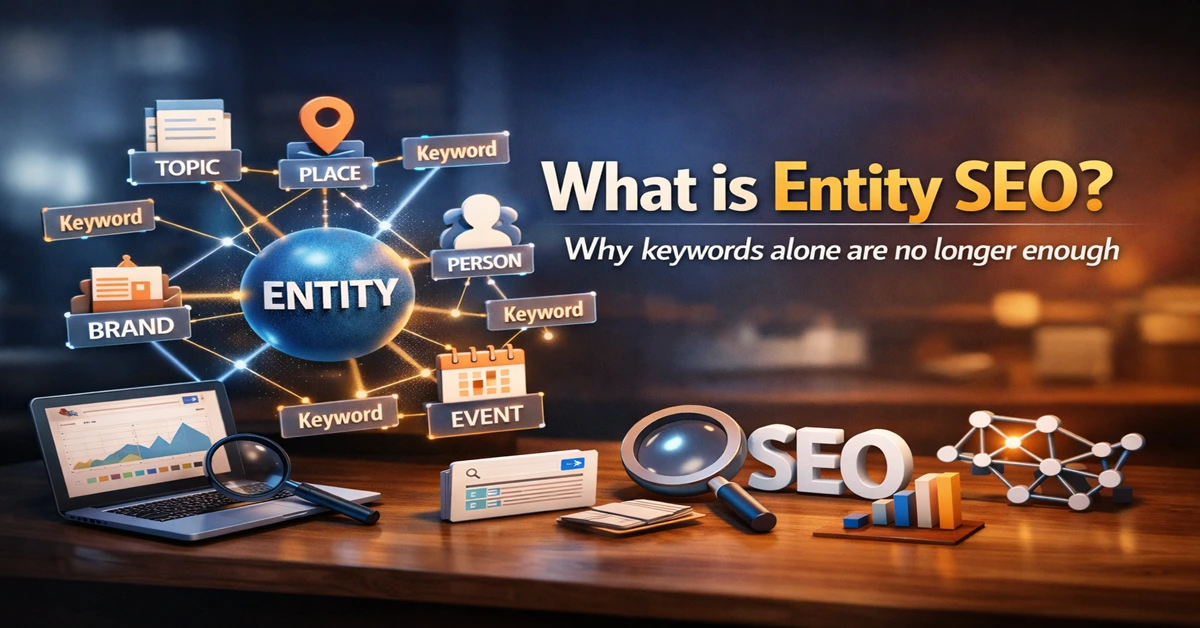
What is entity SEO, and why has it become the most important strategic shift in search optimisation in 2026? The answer starts with a single statistic that should concern every digital marketer: only 12.4% of Fortune 1000 companies have valid Organisation schema linked to a Knowledge Graph ID. That means the overwhelming majority of large businesses are structurally invisible to AI-driven search, regardless of how strong their keyword SEO is.
Meanwhile, Google AI Mode now has 75 million daily active users, AI Overviews appear in 13-25% of all search queries, and brands cited inside AI Overviews earn 35% more organic clicks than those that are not. The businesses capturing that citation advantage are not the ones with the most backlinks or the highest keyword density. They are the ones that have built clear, verified entity authority.
Google no longer just indexes pages and matches keywords. It builds a structured map of real-world things — entities — and their relationships. If your brand, your topics, and your expertise are not clearly mapped in that system, keyword rankings alone will not sustain your search visibility in the AI era.
This guide explains what entity SEO is, how it differs from traditional keyword SEO, why it directly determines AI search visibility, and how to build entity authority step by step. For context on why this shift is happening now, understanding how AI is changing SEO is essential background reading.
| The core shift: keywords get you indexed. Entities get you cited. In 2026, being cited by AI systems is more valuable than being ranked in blue links. |
1. What is entity SEO? A clear definition
Before explaining why entity SEO matters, it needs a precise definition. The term is used loosely across the industry, and the loose usage creates confusion about what actually needs to change in practice.
1.1 The one-sentence definition
Entity SEO is the practice of optimising your brand, content, and digital presence around clearly defined, real-world things so that search engines and AI systems can identify who you are, what you cover, and why you are trustworthy — rather than relying on keyword matching alone.
| Entity SEO formula: Entity SEO = clear identity + structured relationships + verified trust signals |
Where traditional SEO asks “does this page contain the right keywords?”, entity SEO asks “does Google know exactly what this brand is, what it covers, and whether it can be trusted?” The answer to the second question now determines visibility across AI Overviews, Knowledge Panels, and the growing share of search that never produces a blue link at all. Google’s Knowledge Graph currently contains 800 billion facts about 8 billion entities and whether your brand is one of them is increasingly the difference between being visible and being invisible.
1.2 What is an entity?
An entity is a uniquely identifiable thing: a person, organisation, product, location, concept, or event that has a stable, defined meaning independent of the keywords used to describe it.
The distinction matters because keywords are ambiguous. The keyword “Apple” could refer to the fruit, the technology company, or a record label. The entity Apple Inc. has a specific identity, defined attributes (headquarters in Cupertino, CEO Tim Cook, product lines including iPhone and Mac), and verified relationships (subsidiary brands, competitors, founding history) stored in Google’s Knowledge Graph. When a user searches for Apple, Google retrieves the entity not just the text string.
This entity-level understanding is how Google powers Knowledge Panels, AI Overviews, featured snippets, and the rich results that dominate modern SERPs. Every Knowledge Panel you have ever seen is the Knowledge Graph rendering what it knows about an entity. If your brand is not in that graph or is there with incomplete, inconsistent, or conflicting data & it cannot participate in these visibility features.
2. Entity SEO vs keyword SEO: what actually changed
Entity SEO and keyword SEO are not competitors. They are different layers of the same search visibility strategy. Understanding exactly where one ends and the other begins is what turns this from a theoretical distinction into a practical one.
2.1 How keyword SEO works
Traditional keyword SEO is built on text matching. Find a high-volume keyword, optimise it in the page title, H1, meta description, and body copy, earn backlinks, and watch rankings climb. The underlying logic is straightforward: match what users type to what pages say.
This approach worked well when search engines were sophisticated text-matching engines. In that world, a page that mentioned “best running shoes” frequently and had strong backlinks ranked for that query.
2.2 What changed
Google’s natural language processing now identifies nouns and the relationships between them across your entire site & not just the keywords on individual pages. When a user searches “best running shoes for beginners,” Google no longer just matches that text string. It understands “running shoes” as a product entity, “beginners” as a user attribute, and automatically surfaces related entities: specific brands, price ranges, materials, and use cases — even if those words do not appear on your page.
The consequence is that headless content — articles without author identity, brand schema, or external validation is now structurally ambiguous to Google. The algorithm cannot connect it to a trusted entity, which reduces its eligibility for AI citations and rich result features regardless of keyword optimisation quality.
2.3 The right relationship between keywords and entities
Keywords remain how users express intent. Entities are how Google interprets the meaning behind that intent. You need both — keywords to be discoverable, entities to be trusted and cited. The SEO strategies that perform best in 2026 layer entity signals on top of solid keyword foundations rather than treating them as alternatives.
2.4 Side-by-side comparison
| Dimension | Keyword SEO | Entity SEO |
| Goal | Rank pages for target keywords | Be recognised as a trusted, citable entity |
| What Google reads | Keyword frequency, density, placement | Entity identity, relationships, trust signals |
| Success metric | Rankings, organic traffic, CTR | Knowledge Panel presence, AI citations, topical authority |
| Vulnerability | Algorithm updates, competitor content | Algorithm-agnostic; entity trust compounds over time |
| AI search fit | Weak — keywords do not map to AI systems | Strong — AI systems cite entities, not keywords |
| Time to impact | 3-6 months for ranking results | 4-8 weeks (schema), 3-6 months (topical authority) |
3. How Google’s Knowledge Graph works and why your brand needs to be in it
The Knowledge Graph is the technical system that makes entity SEO necessary. Understanding how it works moves entity SEO from an abstract concept to a concrete implementation target.
3.1 What the Knowledge Graph is
The Knowledge Graph is a massive structured database of entities and their relationships — not a list of pages or a keyword index. Google launched it in 2012 and it has grown from 570 million entities at launch to 800 billion facts about 8 billion entities today. It powers Knowledge Panels (the information boxes on branded searches), AI Overviews, featured snippets, entity carousels, and the “People also search for” features that appear across modern SERPs.
When you see a Knowledge Panel for a brand, a person, or a concept, you are seeing the Knowledge Graph displaying its structured understanding of that entity: its name, category, attributes, relationships, and verified external identifiers. This is not constructed from a single page & it’s synthesised from hundreds of consistent signals across the web.
3.2 How Google builds the Knowledge Graph
Google collects entity data from multiple source types, each contributing different signals:
- Structured data (schema markup): explicit, machine-readable declarations on your website about who you are, what you do, and how you connect to other entities
- Wikipedia and Wikidata: primary authoritative sources for entity attributes and relationships & same as links pointing here carry the highest entity trust weight
- Google Business Profile: the primary entity registration mechanism for businesses, especially for local and geographic entity signals
- Authoritative directories: LinkedIn, Crunchbase, Companies House, professional associations each consistent mention reinforces entity identity
- Natural language processing across the web: Google’s NLP identifies entities in content across billions of pages and builds relationships from patterns of co-occurrence
When multiple sources consistently describe the same entity with the same attributes, Google’s confidence in that entity increases. Inconsistency in different brand names across platforms, conflicting descriptions, missing same as links creates entity ambiguity that directly reduces Knowledge Graph confidence and AI citation eligibility.
3.3 Why the Knowledge Graph drives AI search visibility
AI search systems generate answers by pulling verified entities and their relationships from structured knowledge bases, not by scanning full blog posts word by word. Content leveraging entities with structured data improves AI citation probability by over 50%. This is because AI models prioritise well-structured semantic relationships and verifiable facts over keyword density.
For a business, this means Knowledge Graph presence is now a prerequisite for AI search visibility. Pages without entity clarity are ignored by AI systems even if they rank well in traditional blue-link results. The complete GEO framework explains how to optimise specifically for AI-generated search results — but entity SEO is the foundation that GEO builds on.
4. Why keywords alone are no longer enough in 2026
The failure of keyword-only SEO is not theoretical. There are four specific, data-backed reasons why it is structurally insufficient in the current search landscape.
4.1 AI search reads entities, not keyword density
Google AI Mode has 75 million daily active users and is expanding rapidly. When AI systems construct answers, they pull from entity graphs — not from pages that repeat a keyword 15 times. A page with perfect keyword optimisation but no Organisation schema, no sameAs links, and no author identity is essentially invisible to AI-driven search features — the part of search that is growing fastest and delivering the most valuable traffic.
4.2 Zero-click searches demand entity presence at the SERP level
When 60-83% of searches end without a click to any website, the competition for visibility has moved from ranking to being featured inside AI Overviews, Knowledge Panels, and People Also Ask boxes. These features are powered entirely by entity recognition — not by keyword rankings. A business that ranks number one for its target keyword but has no entity presence in the Knowledge Graph earns nothing from the majority of searchers who never click.
4.3 E-E-A-T is evaluated at the entity level, not the page level
Google’s E-E-A-T framework (Experience, Expertise, Authoritativeness, Trustworthiness) is assessed at the entity level across your entire digital presence, not on a page-by-page basis. When Google can clearly identify your brand as a recognised entity, it increases its confidence in all your content as a source of authority. Conversely, faceless content with no author identity, no brand schema, and no external validation is being actively filtered out of AI citations regardless of keyword quality.
This is why understanding SXO alongside entity SEO matters: both frameworks are ultimately about satisfying the searcher completely, not just earning the initial click. Entity trust signals and on-site experience signals work together to build the kind of holistic authority that modern search rewards.
4.4 Topical authority requires entity coverage, not keyword coverage
Google’s algorithm assesses whether a site comprehensively covers a subject area — not whether individual pages contain a target keyword. Building topical authority means creating interconnected content around core entities and their related concepts. The knows about schema property (introduced at scale post-March 2026) allows you to explicitly declare your entity’s expertise areas signalling to AI systems which query categories to cite you for. Organisations using this property are more likely to be cited for queries in their declared domains than equivalent organisations with generic or absent schema.
5. The three pillars of entity SEO
Entity SEO is built on three interconnected pillars. Each one is necessary. None is sufficient on its own. Understanding the distinction between them prevents the common mistake of implementing schema markup without building the surrounding trust signals that make it meaningful.
5.1 Pillar 1: entity definition (who you are)
Google needs to know who or what your brand is without ambiguity. This is the identity layer of entity SEO, and it is the prerequisite for everything else. A clearly defined entity has:
- A consistent name across all platforms: website, social profiles, directories, press mentions
- Organisation schema (JSON-LD format) on the homepage and About page, including name, logo, URL, contact details, and founding information
- sameAs links pointing to verified external sources: Wikipedia, Wikidata, LinkedIn, Crunchbase, and any authoritative directory relevant to your industry
- A structured About page that functions as the “entity home” the definitive on-site declaration of what your organisation is, what it covers, and who leads it
Entity ambiguity where your brand name overlaps with other entities, is inconsistently described, or lacks external verification directly reduces AI citation confidence. Google will not cite a source it cannot confidently identify.
5.2 Pillar 2: entity relationships (how you connect)
Entities gain meaning through their relationships with other entities. A brand entity that exists in isolation carries less authority than one embedded in a rich, verified network of connections. Key relationships to build include:
- Founder and author Person entities: linked author pages with Person schema, professional bios, and sameAs links to LinkedIn and publication profiles
- Product and service entities: Product or Service schema that explicitly defines what your organisation offers and how those offerings relate to the parent entity
- Topic entities: topical content clusters built around core subject areas, with internal linking that signals entity relationships between pages
- Location entities: for local businesses, LocalBusiness schema and Google Business Profile that anchors the brand to a geographic entity
The richer and more accurate your entity relationship map, the more confidently AI systems can cite and represent your brand across a wider range of queries.
5.3 Pillar 3: entity trust (why you are credible)
Being understood is not the same as being trusted. The trust pillar is where E-E-A-T signals operate. It answers the question that entity definition and relationships cannot: why should Google and AI systems treat your entity as an authoritative source?
- Named, credentialled authors with Person schema and linked bios on every piece of content requiring expertise
- Third-party citations and external mentions in industry publications that validate your expertise claims
- Review signals (Google Business Profile reviews, Trustpilot, industry-specific review platforms) that reinforce trustworthiness
- Structured data that makes your entity claims verifiable — pricing, certifications, awards, and qualifications all contribute
AI systems select sources based on verified trust signals. If Google understands your entity but cannot verify its credibility, it will not cite it in high-stakes AI answers. This is closely related to how answer engine optimisation (AEO) works both disciplines depend on the same underlying trust foundation.
6. How to build entity SEO: a practical 5-step framework
The five steps below are sequenced deliberately. Each builds the foundation for the next. Work through them in order to see the fastest and most durable impact on entity authority.
6.1 Step 1: audit your current entity presence
What to do
Search your brand name in Google and observe whether a Knowledge Panel appears. A Knowledge Panel confirms entity presence in the Knowledge Graph. Run your homepage text through Google’s free NLP Demo API to see which entities Google currently identifies in your content and their salience scores — a score between 0 and 1.0 representing how central each entity is to the page. Low salience on your own brand name signals entity ambiguity.
Tools to use
Google Knowledge Graph Search API, Google’s Natural Language API Demo (free), Google Search Console for branded search performance tracking. If no Knowledge Panel exists, the entity definition steps below are the priority fix.
6.2 Step 2: build Organisation schema with sameAs links
What to do
Implement Organisation schema in JSON-LD format on your homepage and About page. Include your brand name, logo URL, website URL, contact details, founding date, and a description. Then add sameAs links — the most impactful element of Organisation schema — pointing to your Wikipedia page (if applicable), Wikidata entry, LinkedIn company page, Crunchbase profile, and any other authoritative directory listings relevant to your industry.
Why sameAs matters
sameAs links are the primary mechanism by which Google connects your website entity to its Knowledge Graph representation. Each verified sameAs link increases Google’s confidence that all of these digital properties describe the same real-world entity. This is the single highest-leverage entity SEO implementation for most businesses.
6.3 Step 3: add Person schema for all content authors
What to do
Every piece of content requiring expertise should have a named author with a linked author page and Person schema. The author page must include the author’s full name, professional bio, areas of expertise, links to their LinkedIn profile and published works, and where applicable a sameAs link to their Wikipedia or Wikidata profile.
Why this is critical in 2026
AI engines cross-reference author names against LinkedIn, professional directories, and publication history to verify content credibility. Faceless content without a credentialled author is actively filtered from AI citations. Named, schema-marked authors are not optional for competitive content in 2026 they are the E-E-A-T trust layer that makes AI citation possible. Implementation tools: RankMath Pro or Yoast Premium for WordPress.
6.4 Step 4: build topic clusters around core entities
What to do
Identify your three to five primary topical entities — the subject areas your brand should own. For each, create a hub page (the primary entity page) and a set of supporting content that explores related sub-entities and concepts. Use internal linking to explicitly connect related content and signal the entity relationships to search engines.
The knowsAbout advantage
Add the knowsAbout property to your Organisation schema, explicitly declaring which topic entities your brand has expertise in. An organisation that declares knowsAbout: [digital marketing, SEO, content strategy] is measurably more likely to be cited for queries in those domains than an equivalent organisation with no topic declarations. This is one of the highest-impact schema additions available post-March 2026.
Tools to use
InLinks and WordLift for entity relationship mapping and semantic annotation. MarketMuse for topical authority gap analysis. Google’s NLP API for competitor entity analysis — paste competitor content to see which entities they are recognised for.
6.5 Step 5: build external entity validation
What to do
Google’s confidence in your entity increases when third-party sources consistently describe you in the same way. External validation is the trust multiplier that activates the entity definition and relationship work from the previous steps.
Priority validation sources
- Industry publications: earn mentions and citations in authoritative publications relevant to your sector
- Google Business Profile: maintain a complete, active, and review-rich profile & this is a primary entity data source for Google
- Authoritative directories: LinkedIn company page, Crunchbase, Companies House with consistent presence across these platforms reinforces entity identity
- Wikipedia and Wikidata: where achievable for your organisation or key team members, these are the highest-trust entity validation sources available
Monitor entity progress using Google Search Console (Knowledge Panel appearances and branded search trends), Google’s NLP API (entity salience scores over time), and AI Overview appearance tracking for your core query categories.
7. Entity SEO tools: the practical stack
The tools below are organised by implementation stage. Each serves a specific function in the entity SEO workflow rather than overlapping with each other.
7.1 Entity audit tools
- Google NLP API Demo (free): identifies which entities Google sees in your content and their salience scores — the most diagnostic free tool in entity SEO
- Google Knowledge Graph Search API: query your brand entity directly to check presence, attributes, and Knowledge Graph ID
- Google Search Console: track Knowledge Panel appearances, branded search volume trends, and structured data error reports
7.2 Schema implementation tools
- RankMath Pro and Yoast Premium: WordPress schema implementation including Organisation, Person, Article, FAQ, and Product schema with sameAs field support
- Schema App: for complex multi-entity schema across large or enterprise sites where manual implementation is impractical
- Google Rich Results Test and Schema Markup Validator: validation tools to confirm schema is correctly implemented and eligible for rich results
7.3 Entity relationship and content planning tools
- InLinks: entity mapping, salience scoring, and content gap analysis based on entity coverage
- MarketMuse: topical authority planning and content brief generation around primary entities
- WordLift: semantic annotation and entity-based internal linking for WordPress and custom CMS
7.4 Entity monitoring tools
- Google Alerts: track external brand and entity mentions as they appear across the web
- Semrush or Ahrefs: monitor branded search performance, Knowledge Panel changes, and AI Overview appearances for target queries
- BrightEdge: enterprise-level AI search visibility tracking including entity citation monitoring across Google, Perplexity, and ChatGPT Search
Entity SEO in 2026: the bottom line
Entity SEO is not a replacement for keyword optimisation. It is the layer that determines whether your keyword-driven rankings translate into AI citations, Knowledge Panel visibility, and the kind of brand authority that compounds over time rather than decaying with each algorithm update.
The 2026 reality is clear: keywords get you indexed. Entities get you cited. And in an environment where 65% of searches end without a click and AI Overviews appear in up to 25% of all queries, being cited inside AI results is now more valuable than ranking in blue links. The businesses building that citation advantage are the ones investing in entity clarity now.
Entity SEO connects directly to GEO (generative engine optimisation) and AEO (answer engine optimisation), the disciplines that determine visibility in AI-generated answers and voice search results. Building your entity foundation now creates the structural advantage that both of those emerging frameworks depend on.
Has your brand started building entity authority yet? Do you have a Knowledge Panel, consistent Organisation schema, and credentialled author pages in place? Or are you still optimising purely for keywords? Share where you are in the transition in the comments below.
FAQs about Entity SEO:
Entity SEO is the practice of optimising your brand, content, and digital presence so that search engines can clearly identify you as a trustworthy, real-world entity rather than a collection of keywords. It combines structured data (schema markup), consistent entity signals across platforms, and E-E-A-T trust signals so Google and AI systems can confidently cite and represent your brand in AI Overviews, Knowledge Panels, and modern search results.
No. Entity SEO and keyword SEO work together. Keywords remain how users express intent and how search engines identify which entity a page is about. Entity SEO provides the structural context that makes those keywords trustworthy and meaningful. The most effective 2026 search strategy combines keyword research for user intent with entity optimisation for verified authority. Neither alone is sufficient — keywords without entity context are structurally ambiguous, and entity presence without keyword signals is invisible to users.
Search your brand name in Google and check whether a Knowledge Panel appears on the right side of the results. A Knowledge Panel confirms Knowledge Graph presence. You can also query the Google Knowledge Graph Search API directly with your brand name to check whether a Knowledge Graph ID exists and what attributes Google has assigned to your entity. If no Knowledge Panel appears, implementing Organisation schema with sameAs links and building consistent external directory presence are the priority first steps.
Entity SEO focuses on defining and structuring identifiable things (your brand, authors, products, topics) so search engines know exactly what they are. Semantic SEO focuses on the meaning and contextual relationships between content topics — how concepts connect and relate to each other. In practice, the two overlap significantly: entity SEO identifies what something is, and semantic SEO explains what it means and how it connects. Both are required for full AI search visibility. The SXO guide at Blog Arena 360 covers how on-site experience signals complement entity and semantic SEO in a complete 2026 search strategy.
Entity SEO improvements show results across different timeframes. Schema markup additions are typically re-crawled within two to four weeks and reflected in Google’s structured data understanding. Knowledge Panel appearances for brands with strong external validation can emerge within four to eight weeks of implementing sameAs links. Topical authority built through content clusters typically takes three to six months to establish. External entity validation through Wikipedia entries, directory listings, and third-party citations compounds progressively as Google’s confidence in your entity grows over time.