Here is a number that should make every online business owner pause: the average digital marketing funnel converts between 3% and 10% of visitors into customers. Which means 90 to 97 out of every 100 people who discover your business online leave without buying anything.
Most business owners respond to this by spending more on ads, assuming the problem is traffic. But pouring more traffic into a leaky funnel is like filling a bucket with a hole. The water goes in, the water comes out, and you keep refilling wondering why the bucket stays empty.
The real problem is almost always the funnel itself. Fixing a funnel is dramatically cheaper and more impactful than buying more traffic.
The blog on how to create a digital marketing strategy gives you the strategic framework this funnel fits into.
What Is a Digital Marketing Funnel and Why Does Every Online Business Need One?
The plain language definition
A digital marketing funnel is the structured path you design for a complete stranger to go from first discovering your business to becoming a paying customer and ideally a repeat one. It is called a funnel because a large number of people enter at the top and a smaller number complete a purchase at the bottom.
Without a deliberate funnel, businesses rely on luck. Someone sees your Instagram ad, lands on your website, gets confused or distracted, and leaves. Without a system designed to move them from that first impression toward a purchase, most simply never come back.
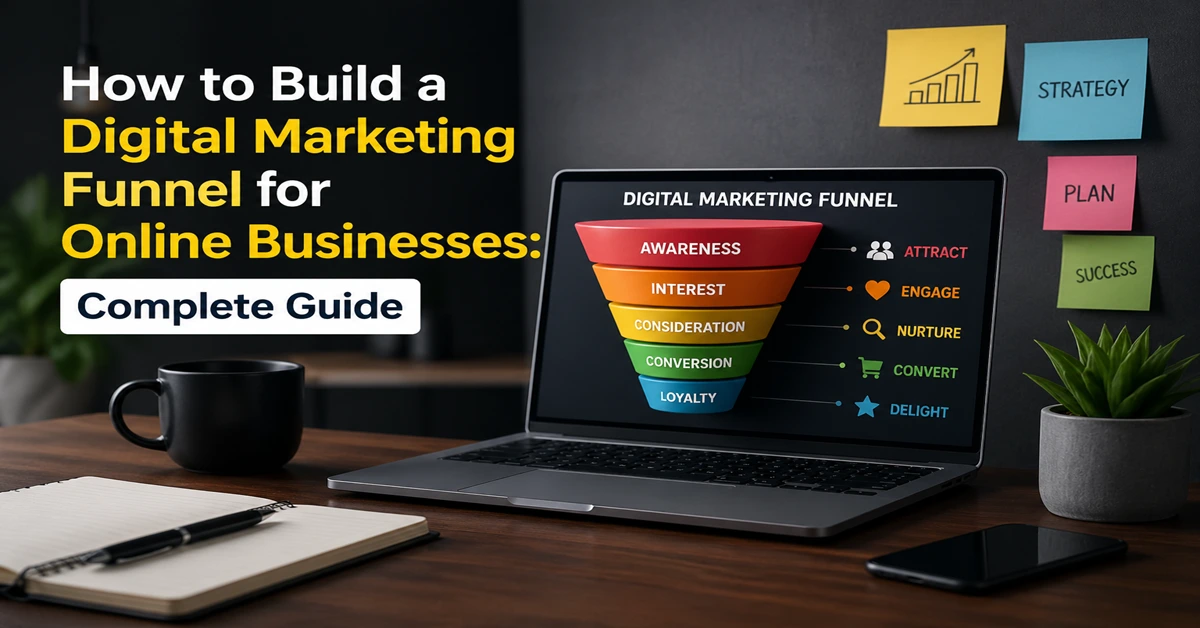
The four stages every digital marketing funnel must have
- Awareness (Top of Funnel): The person discovers your business for the first time. They do not know you, do not trust you, and are not ready to buy. Your job is to be visible and relevant.
- Consideration (Middle of Funnel): The person is evaluating whether you are the right solution. They are comparing options and consuming your content. Your job is to build trust and demonstrate expertise.
- Conversion (Bottom of Funnel): The person is ready to buy. Your job is to make the purchase as frictionless as possible and give them a reason to act now.
- Retention (Post-Funnel): The person has bought. Your job is to deliver on what you promised, keep them engaged, and turn them into a repeat customer and referrer.
| Why retention matters most: Acquiring a new customer costs 5 to 7 times more than retaining an existing one. A 5% improvement in customer retention can increase profitability by 25 to 95%. Most online businesses invest heavily in the first three stages and almost nothing in the fourth, which is exactly backwards if long-term profitability is the goal. |
Why Most Digital Marketing Funnels Fail: The Numbers That Explain It
| 90-97% | of website visitors leave without buying, meaning most funnels are losing the vast majority of the people they reach |
| 82.9% | of landing page visits come from mobile devices, yet mobile converts 8% less efficiently than desktop. A gap most businesses never address. |
| 40.1% | average conversion rate for interactive quiz-based lead capture vs just 2 to 3% for static contact forms (Interact, 2026) |
| 220% | more leads generated by long landing pages compared to shorter ones, yet most Indian business websites use brief single-page formats |
| 48% | increase in conversion rate when live chat is added to a website, yet fewer than 20% of Indian SMB websites have any real-time support tool |
The five most common digital marketing funnel failure points that appear across almost every business size and industry:
- No clear next step at each stage. A visitor reads your blog post and then has nowhere obvious to go. No offer, no email capture, no related content link. They hit a dead end and leave.
- Top-of-funnel traffic sent directly to a product page. Cold traffic sent straight to a Buy Now page converts extremely poorly because the trust required for a purchase has not been built.
- No nurturing sequence between awareness and purchase. Most people do not buy on first contact. They need multiple touchpoints before they are ready. Businesses without an email or WhatsApp sequence lose these people permanently.
- Checkout friction. Too many form fields, limited payment options, slow mobile loading, or a confusing payment UX are responsible for a significant portion of lost sales at the very bottom of the funnel.
- No post-purchase plan. The customer buys and hears nothing. No follow-up, no cross-sell, no referral request. The relationship ends at transaction rather than beginning there.
Building Each Stage of Your Digital Marketing Funnel
Here is how to build each stage deliberately, with the channels, content types, and India-specific considerations that matter at each level.
Stage 1: Awareness (Top of Funnel)
Goal: Make your target audience aware that your business exists and that it is relevant to a problem they have.
Channels: SEO and organic search, Instagram Reels and YouTube Shorts, Meta and Google ads, influencer collaborations, LinkedIn for B2B, podcast mentions.
Content types: Short-form video, educational blog posts targeting problem-awareness keywords, social media carousels, Google Display ads, YouTube pre-roll ads.
Key metric: Reach and impressions at top level, then click-through rate as the bridge to the next stage.
India-specific tip: India has 950 million internet users but over 68% prefer regional language content. A Hindi or Tamil awareness campaign can reach audiences your English-only competitors are entirely invisible to. Reels in regional languages with subtitles consistently outperform English-only content for top-of-funnel reach in non-metro markets.
Stage 2: Consideration (Middle of Funnel)
Goal: Build enough trust that the person moves from awareness to genuine interest in your specific solution.
Channels: Email marketing, WhatsApp Business, YouTube tutorials, comparison blog posts, webinars, retargeting ads, Google Search ads for solution-aware keywords.
Content types: Detailed how-to guides, case studies, product comparison content, free resources like checklists, customer testimonials, FAQ pages, free trials or demos.
Key metric: Email open rate, content engagement time, retargeting ad CTR, lead magnet download rate.
India-specific tip: Indian consumers at the consideration stage heavily rely on peer reviews from people similar to themselves. A testimonial from a customer in the same city or occupation converts significantly better than a generic five-star review. Regional language testimonials are especially powerful for non-metro audiences. WhatsApp is India’s most powerful mid-funnel nurturing channel because it sits between the formality of email and the immediacy of a phone call.
Stage 3: Conversion (Bottom of Funnel)
Goal: Remove every possible barrier between the person and completing a purchase.
Channels: Landing pages, checkout flow, WhatsApp sales conversations, Google Search ads for brand keywords, retargeting ads with specific offers, email conversion sequences.
Content types: Testimonial-heavy sales pages, limited-time offer emails, abandoned cart recovery messages, comparison pages, money-back guarantee messaging.
Key metric: Conversion rate, cost per acquisition, cart abandonment rate, checkout completion rate.
India-specific tip: UPI has eliminated the biggest friction point in the Indian purchase funnel. Offer UPI as the primary payment option rather than burying it below card options. For high-ticket purchases above Rs 5,000, many Indian consumers want to speak to someone before committing. Building a WhatsApp or phone CTA into your bottom-of-funnel landing page captures these buyers who would otherwise leave without converting.
Stage 4: Retention (Post-Purchase)
Goal: Turn a one-time buyer into a repeat customer, a loyal advocate, and ideally a source of referrals.
Channels: Email sequences, WhatsApp follow-ups, loyalty programmes, exclusive community access, referral programmes, personalised recommendations.
Content types: Post-purchase onboarding emails, user-generated content requests, loyalty reward announcements, exclusive customer content, referral incentive campaigns.
Key metric: Repeat purchase rate, customer lifetime value, net promoter score, referral programme participation rate.
India-specific tip: Indian consumers respond extremely well to WhatsApp-based post-purchase communication. A WhatsApp message confirming delivery and asking for feedback generates significantly higher response rates than email.
For D2C brands, a WhatsApp group for loyal customers creates community and dramatically increases repeat purchase rates. Festival-season loyalty campaigns timed around Diwali, Holi, and Eid are among the highest-ROI retention activities available to Indian online businesses.
How the Indian Market Requires Funnel Adaptations Most Global Guides Miss
WhatsApp is not optional in an Indian funnel
AI WhatsApp marketing for Indian businesses covers exactly how to build this into your funnel.
Festival seasonality must be built into your funnel calendar
India has more major shopping festivals than almost any other market: Diwali, Navratri, Onam, Eid, Pongal, Holi, Christmas, and dozens of regional festivals. Each one represents a concentrated consumer spending peak where conversion rates spike significantly higher than normal periods. A funnel without festival-specific bottom-of-funnel campaigns misses its most profitable conversion windows. Build specific campaigns for each major festival relevant to your audience three to four weeks in advance.
Regional language content expands your funnel reach dramatically
68% of Indian internet users prefer content in their native language. A funnel running entirely in English is invisible to a huge portion of the available market. You do not need to translate everything. Adding Hindi versions of your highest-traffic landing pages and your most important email sequences can meaningfully increase conversion rates for non-metro traffic.
Phone calls are still a conversion channel
For high-ticket products and services, Indian consumers frequently want to speak to someone before completing a payment even when the entire discovery journey happened online. A bottom-of-funnel landing page without a prominent click-to-call or WhatsApp contact option is losing a significant portion of high-intent visitors who are ready to buy but not ready to pay without speaking to a human first.
Trust signals matter more in India than in most markets
Indian consumers, particularly those buying from a new brand, place exceptional weight on trust signals. These include prominently displayed customer reviews from Indian customers in recognisable cities, money-back guarantees with clear terms, COD options for physical products, recognised payment logos (UPI, Razorpay), and a registered business address. Each of these reduces the risk perception that prevents first purchases.
Tools to Build Your Digital Marketing Funnel in India
| Funnel stage | Tool | What it does | Cost |
| Awareness | Google Search Console | Tracks organic search visibility and keyword performance | Free |
| Awareness | Meta Ads Manager | Runs Facebook and Instagram awareness campaigns | Ad spend only |
| Consideration | Mailchimp or Brevo | Email nurturing sequences for mid-funnel leads | Free tier available |
| Consideration | Interakt or AiSensy | WhatsApp Business API for automated nurturing | Rs 999/month+ |
| Consideration | Hotjar | Heatmaps and session recordings to see where visitors drop off | Free tier available |
| Conversion | Razorpay or PayU | Payment gateway with UPI, cards, EMI, and COD | Transaction fee |
| Conversion | Tidio or Freshchat | Live chat to convert high-intent bottom-of-funnel visitors | Free tier available |
| Conversion | Google Optimize or VWO | A/B testing landing pages and checkout flows | Free / paid |
| Retention | Zoho CRM or HubSpot | Customer data management and automated follow-up sequences | Free tier available |
| Analytics | Google Analytics 4 | Full funnel tracking from first visit to purchase and beyond | Free |
How to Build Your Digital Marketing Funnel Step by Step
Follow this sequence. Skipping steps creates gaps that cost you customers at every stage of your digital marketing funnel:
- Map your customer journey before building anything. Write down every touchpoint a typical customer has with your business from first discovery to their third purchase. Include the questions they ask themselves at each stage, the doubts they have, and the information they need to move forward. This map becomes the blueprint for everything you build.
- Define one specific action at each funnel stage. Awareness: a website visit or social follow. Consideration: an email or WhatsApp opt-in. Conversion: a purchase. Retention: a second purchase or referral. Every piece of content and every channel should be designed around moving people toward that specific next action.
- Build your consideration stage first, not your awareness stage. Most businesses start by running ads before they have any system to capture and nurture the leads those ads generate. Build your email or WhatsApp nurturing sequence and create your lead magnet before spending a single rupee on paid awareness.
- Create your conversion landing page with one goal only. Remove the navigation menu. Remove anything that does not directly contribute to the purchase decision. Add three to five customer testimonials from people similar to your target buyer. Make UPI and card payment prominently visible.
- Set up your post-purchase sequence before you launch. Your post-purchase WhatsApp or email sequence should confirm the order, set delivery expectations, check in after delivery, and ask for a review or referral within the first two weeks of the customer relationship.
- Add tracking to every stage before running any traffic. Install Google Analytics 4 and set up conversion events for every key action: email sign-up, WhatsApp opt-in, add to cart, checkout start, purchase completed, and post-purchase review submitted.
- Run traffic to the top of your funnel only after the middle and bottom are ready. Once your nurturing sequence is live, your landing page is tested, your checkout is smooth, and your post-purchase flow is set up, now you invest in awareness. Traffic to a complete funnel compounds. Traffic to an incomplete funnel evaporates.
How to Measure Whether Your Digital Marketing Funnel Is Actually Working
| Stage | Key metric | Benchmark to aim for |
| Awareness | Click-through rate (CTR) | 2 to 5% for display, 3 to 7% for search |
| Consideration | Email open rate | 25 to 35% for warm lists |
| Consideration | Lead magnet conversion rate | 20 to 40% |
| Conversion | Landing page conversion rate | 3 to 10% across industries |
| Conversion | Cart abandonment rate | Below 65% (industry avg is 70%+) |
| Retention | Repeat purchase rate within 90 days | 20 to 40% |
| Overall | LTV to CAC ratio | 3:1 or higher for sustainable growth |
The most important ratio to track is LTV to CAC (Customer Lifetime Value to Customer Acquisition Cost). If it costs you Rs 500 to acquire a customer and that customer spends Rs 800 total, your funnel is barely profitable. If your CAC is Rs 500 and your LTV is Rs 3,000, every marketing rupee you spend compounds meaningfully. Improving LTV through retention is almost always more impactful than reducing CAC through ad optimisation.
Common Digital Marketing Funnel Mistakes Indian Online Businesses Make
Sending cold ad traffic directly to a product page
A person who has never heard of your brand is not ready to buy. Sending them directly to a product page generates poor conversion rates and wastes ad spend. Instead, send cold traffic to a value-first landing page that captures their email or WhatsApp number in exchange for something useful. Then nurture them toward purchase over the following days.
Building one funnel for all products and all audiences
A customer buying a Rs 299 impulse purchase needs a very different funnel from a customer considering a Rs 15,000 course. The consideration time, trust requirements, and conversion touchpoints are completely different. Businesses that run all products through the same funnel optimise for nothing in particular and convert poorly across the board.
Ignoring mobile experience
82.9% of landing page visits in India come from mobile devices. Yet the majority of Indian business websites are designed and tested on desktops. A funnel that converts 4% on desktop but 1.5% on mobile is leaving most of its potential revenue on the table. Test every stage of your funnel on a mid-range Android phone on a 4G connection before running any traffic to it.
No follow-up after a cart abandonment
In India, cart abandonment rates typically exceed 70%. A significant portion of those abandoned carts come from buyers who were genuinely interested but got distracted or wanted to think about it. An automated WhatsApp message sent 20 to 30 minutes after abandonment, followed by a second one 24 hours later, recovers 15 to 25% of those abandoned carts with minimal additional spend.
Your Digital Marketing Funnel Is the Foundation Everything Else Builds On
Every ad you run, every piece of content you create, and every rupee you invest in marketing eventually flows through your funnel. A well-built funnel amplifies all of that investment. A leaky funnel drains it.
The good news is that most of what makes a funnel effective is not about budget or sophisticated technology. It is about understanding your customer’s journey, creating the right content at each stage, removing friction from the path to purchase, and following up with the people who almost converted but did not quite make it.
India’s digital market gives you unique advantages: UPI has eliminated payment friction, WhatsApp gives you a direct line to customers that no other market has in the same form, and the sheer scale of the connected Indian population means even a niche product can find a meaningful audience. To make every stage of your funnel more relevant to each individual customer, our guide on AI personalization in marketing for Indian small businesses is the natural next read.
Build one stage at a time. Measure what changes. Iterate from there. And if you want to share your own funnel-building experience with an audience of Indian marketers, visit our Write for Us page on Blog Arena 360.
| Disclaimer: This article is for informational and educational purposes only. Conversion rate benchmarks vary by industry, audience, and implementation quality. Tool pricing changes regularly. Verify current details on each platform’s official website before making purchasing decisions. |
FAQs about Digital Marketing Funnel
A digital marketing funnel is the structured path you create for someone to go from first discovering your business to becoming a paying customer. It is called a funnel because many people enter at the top through awareness and a smaller number complete a purchase at the bottom. Each stage has a specific job and specific content designed to move the person toward the next step.
A basic funnel with one awareness channel, a lead capture page, a simple email sequence, and a payment-enabled landing page can be built in two to four weeks using tools like Mailchimp, Razorpay, and a page builder like Wix or Carrd. A more sophisticated funnel with WhatsApp integration, multiple segments, and automated post-purchase sequences typically takes one to three months to build and optimise.
Most sales funnels convert between 3% and 10% of visitors into customers. B2B funnels typically convert between 1% and 5% due to longer buying cycles. B2C funnels often convert between 5% and 15% for well-optimised pages. Email converts at 19.3% on average, significantly outperforming paid social or display. If your funnel is converting below 2%, the issue is almost always friction at the conversion stage rather than insufficient awareness traffic.
Not necessarily, but you need separate funnels for meaningfully different audience segments or price points. A Rs. 299 impulse purchase and a Rs. 15,000 course require different consideration periods, trust-building content, and conversion mechanics. As a starting point, create one funnel for your most important product and get it working before building more.
All four stages matter, but if you are early in building your funnel, the consideration stage is where most businesses have the biggest gap. Most Indian online businesses invest in awareness through ads but have no structured system to capture and nurture the people those ads attract. Building a solid email or WhatsApp nurturing sequence typically delivers a bigger return than increasing ad spend at the top of the funnel.