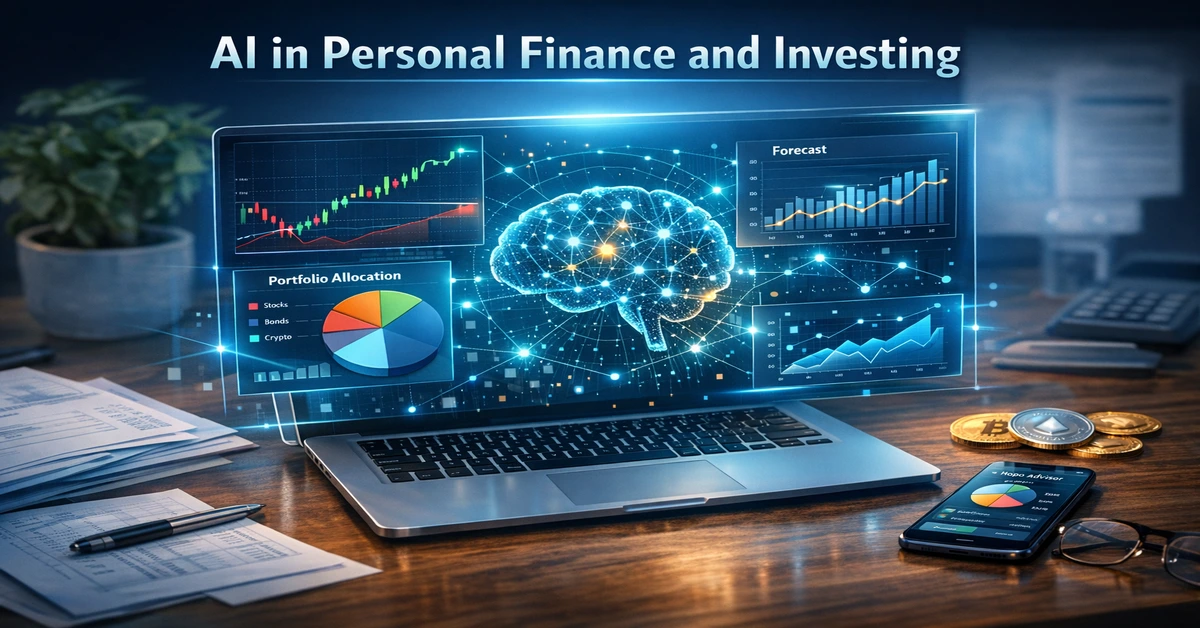
Managing money has actually changed significantly in recent times, and this change is more profound compared to just five years ago. Budgeting apps can now forecast expenditure, while investing apps can automatically adjust investments. Arguably, the solution behind this change is AI in Personal Finance, which is transforming how individuals save, invest, and plan for the future.
For instance, whereas an individual would have been forced into irrational guesswork in the past, present-day individuals can use data-driven information, which was traditionally available only to banks. And this is not just automation; this is informed decision-making.
Through applications that forecast money availability to investing tools that lightly adjust investments, technology has seeped into our lives like a thief in the night and changed the way money works. It is not just about technology; it is about technology that is precise and personalized.
Let’s take a step-by-step look at what’s changing, and what that means for investors, savers, and anyone else trying to build a level of stability financially.
What Is AI in Personal Finance and Why It Matters Today?
Artificial Intelligence in Personal Finance means using intelligent algorithms and models to aid individuals in budgeting, investing, and saving through analyzing large amounts of data and drawing meaningful conclusions.
Contrary to traditional software, which performs tasks following a set of rules, AI learns through its own behavior and improves through time. This means that “your financial dashboard today could offer more intelligent advice than it provided just six months ago.”
As per the research carried out by McKinsey & Company, financial institutions that take bold steps to adopt AI technologies can achieve up to 25% more profitability than their competitors.
In this way, the speed of technology adoption helps underscore the importance of AI in the field of Personal Finance.
The Rise of Artificial Intelligence in Finance:
In finance, artificial intelligence’s initial adoption can be traced back to its applications in large financial organizations like hedge funds and banks. Its initial use cases were focused on fraud detection systems, credit scoring models, and underwriting systems.
Today, Artificial Intelligence in finance is affecting almost all layers of financial services, including:
- Real-Time Fraud Monitoring
- Loan risk assessment
- Automated customer support
- Algorithmic trading
- Compliance automation
For example, the World Economic Forum points out that “Artificial intelligence-powered financial systems are making processes more efficient and decreasing operating expenses for global institutions.”
One of the strongest examples of this is fraud detection. According to the Association of Certified Fraud Examiners, organizations using AI-based analytics to detect fraud do this much faster than those using traditional, non-automated systems.
This brings out how Artificial intelligence in finance enhances profit and security.
How AI Powered Financial Planning Is Changing Wealth Management?
AI-powered financial plans will make high-level strategies for building wealth available to ordinary people.
Traditionally, financial planning involves regular meetings with an advisor. AI-powered financial planning packages can:
- Automatic tracking of spending
- Adjust savings targets dynamically
- Simulate retirement outcomes
- Offer tax optimization insights
A few years ago, I had personally used a digital platform for planning one of my major expenses. Instead of speculating how it could impact my investments, it allowed me to try various scenarios. It made instant changes based on the inflation rates. Such a level of clarity has reduced uncertainty to a great extent.
In fact, a study done by Deloitte Insights indicates that AI-based financial advisory platforms enhance personalization and boost client satisfaction.
AI-powered financial planning certainly does not replace the financial advisor but rather enhances the value of the advisor through better data.
In addition, to all the readers who are developing their financial foundations, preventing premature mistakes is just as critical. This is similar to Finance Mistakes 90% of People Make and How to Avoid Them
Knowledge of common pitfalls helps enhance the potency of AI-driven strategies.
AI Tools for Personal Finance: Smarter Everyday Decisions:
AI-based personal finance tools have become surprisingly mainstream. Many use them without understanding how serious the technology is behind it all.
Distinguishing features include:
- Categorization of expenses automated
- Cash flow forecasting
- Credit score monitoring
- Bill reminders
- Spending pattern alerts
The Consumer Financial Protection Bureau recognizes the growing trend of digital tools in finance, promoting transparency and helping consumers make more-informed decisions.
The CFPB is working towards reforming consumer financial markets by providing regular supervision, enforcing federal law, writing rules, studying consumer behavior and trends, and raising awareness through financial education.
AI-powered personal finance services can do this by looking at transaction histories and uncovering trends that often don’t get noticed by humans, like subscription fatigue or seasonal surges in spending.
This kind of predictive assistance builds better habits over time.
AI in Investing: A Data-Driven Shift
AI in investment has resoundingly altered the way capital allocation is effectuated. Gone are the days of heavy reliance upon analyst views; investors today bank on extensive data processing.
AI in investing can:
- Analyze corporate earnings instantly
- Follow global macroeconomic indicators.
- Anomalous trading patterns
- Process sentiment from financial news
But according to PwC’s Global Artificial Intelligence Study, AI might contribute up to 15.7 trillion dollars to the global economy by 2030, and one of the major beneficiaries of this will be financial services.
Assuming that human bias hasn’t caused discriminatory policies, machines can make biased decisions.
AI in investing reduces emotional decision-making. During turbulent markets, automated systems follow predefined strategies instead of reacting impulsively.
Machine Learning in Stock Market Analysis
Machine learning in a stock market environment is concerned with recognizing patterns. The algorithms are designed to learn from historical price movements, trading volumes, and other macroeconomic indicators.
Sophisticated hedge funds employ machine learning in stock exchange analysis for identifying correlations among thousands of variables.
In the Journal of Financial Data Science, the researchers found that machine learning models perform better than traditional linear models during periods of volatility.
Similarly, learning machines in stock market strategies do not remove risk; instead, they strengthen probability.
Robo Advisors for Investing: Access and Affordability
Robo-advisors for investment are automated platforms that assist in portfolio creation and management according to an investor’s preference.
Such systems usually:
- Assessing risk tolerance
- Assets Allocation across ETFs
- Rebalance periodically
- Dividend reinvestment
The Securities and Exchange Commission of the United States offers information on robo advisors and how they use algorithms in their portfolios.
Robo-advisors in investing save money compared to a traditional investment advisor and offer the opportunity for a beginner investor to obtain a diversified portfolio too.
AI Investment Management and AI Driven Portfolio Management
Investment management backed by AI improves efficiency and scalability. AI driven portfolio management adds responsiveness to changing markets.
AI in investment management is a system of constantly monitoring and adjusting investments through the aid of algorithmic systems.
Further, AI-driven portfolio management makes more dynamic portfolio allocation based on following:
- Risk metrics
- Market signals
- Sector performance
- Economic Forecasts
The CFA Institute discusses how the adoption of AI is changing the way asset management is carried out, enhancing techniques for building portfolios
AI investment management increases efficiency and scalability. AI-based portfolio management provides added responsiveness to changing markets.
Predictive Analytics in Finance:
In finance, predictive analytics is the process of forecasting using historical as well as real-time information.
Applications include:
- Predicting Credit Defaults
- Supplier
- Spending trend forecasting
- Market Downturn Simulations
- Liquidity planning
Financial services organizations are at the top of the list of industries adopting predictive analytics systems, as per the IBM Global AI Adoption Index. Predictive analytics in finance institutions.
AI Driven Demand Forecasting in Finance and Investment Markets:
Demand forecasting carried out by AI involves analysis of capital flows, demand in different sectors, and the behavior of investors.
Institutional investors prefer AI-driven demand forecasting as it helps them understand where capital is flowing before traditional signals confirm trends.
It is noteworthy that it is related to the forward-thinking strategies that are discussed here:”‘Top Investment Trends to Watch in 2026’
Integration of AI-based demand forecasting and macroeconomic trend analysis can enhance long-term portfolio positioning strategies.
Real-World Applications of AI in Personal Finance:
Practical Applications of AI in Personal Finance:
- Retirement goal simulation
- Emergency fund projections
- Debt payoff optimization
- Smart budgeting recommendations
On the institutional side, AI in Personal finance enables automation in financial compliance and in high-frequency trading systems.
These applications demonstrate that AI in Personal Finance is not just experimental. It is deployed; it is operational.
Future of AI in Financial Services:
The future of AI development in the financial sector may revolve around:
- Hyper-personalized
- Real-time Fraud Intervention
- Ethical Algorithm Transparency
- Hybrid Models of Human and AI Advisors
In addition, the Bank for International Settlements provides information on the implications of the adoption of AI technology. The future of AI in financial services will require balancing innovation with accountability.
Benefits and Risks of AI in Personal Finance and Investing:
| Benefits | Risks |
| Data-backed decisions – Recommendations are based on large datasets, not guesswork | Algorithmic bias – Biased training data can lead to skewed outcomes |
| Faster analysis – Markets and financial patterns are processed instantly | Model misinterpretation – Forecasts may be misunderstood as guarantees |
| Reduced human bias – Limits emotional investing driven by fear or hype | Overdependence on automation – Blind trust can weaken critical judgment |
| Lower costs – Automation reduces advisory and operational expenses | Data privacy exposure – Sensitive financial data requires strong security |
| Increased access – More people can use advanced financial tools | – |
The Future of AI in Personal Finance and Investing:
AI in Personal Finance is revolutionizing the way money is handled by individuals and organizations alike. AI in investing, AI powered financial planning, and AI driven portfolio management are making financial strategies “smarter” and “adaptive”.
Artificial intelligence is not exclusive to financial institutions, but it is also beneficial to the individual investors. From “robo-advisors” used for investment to “predictive analytics in finance,” the tools find their way to investors.
The future of artificial intelligence is based on responsible innovation, robust regulation, and well-informed users. With actions based on both financial literacy and discipline, artificial intelligence emerges as a powerful ally for long-term wealth accumulation.
FAQs about AI in Personal Finance:
AI in Personal Finance uses smart algorithms to analyze your spending, savings, and investing patterns. Instead of manually tracking everything, it helps you make better financial decisions based on real data and personalized insights.
AI in investing processes huge amounts of market data in seconds. It helps investors identify trends, manage risk, rebalance portfolios, and make more disciplined decisions without relying only on emotions.
Robo advisors for investing are regulated platforms that use algorithms to manage diversified portfolios. They are generally safe, but like all investing, returns depend on market conditions and your risk tolerance.
Machine learning in stock market analysis can detect patterns and probabilities from historical data. However, it cannot predict the market with certainty because economic events and investor behavior are unpredictable.
The future of AI in financial services will likely include more personalized financial planning, smarter portfolio management, faster fraud detection, and closer collaboration between human advisors and AI systems.
Related Blogs:
Top Investment Trends to Watch in 2026
Personal Finance Mistakes 90% of People Make and How to Avoid Them