Artificial intelligence is no longer limited to research labs or science fiction stories. It now helps people write content, analyse data, recommend products, and automate routine tasks. At the same time, human thinking continues to drive creativity, ethics, leadership, and emotional connection. Understanding how machine systems differ from human thinking helps reduce confusion and unrealistic expectations about what technology can and cannot do.
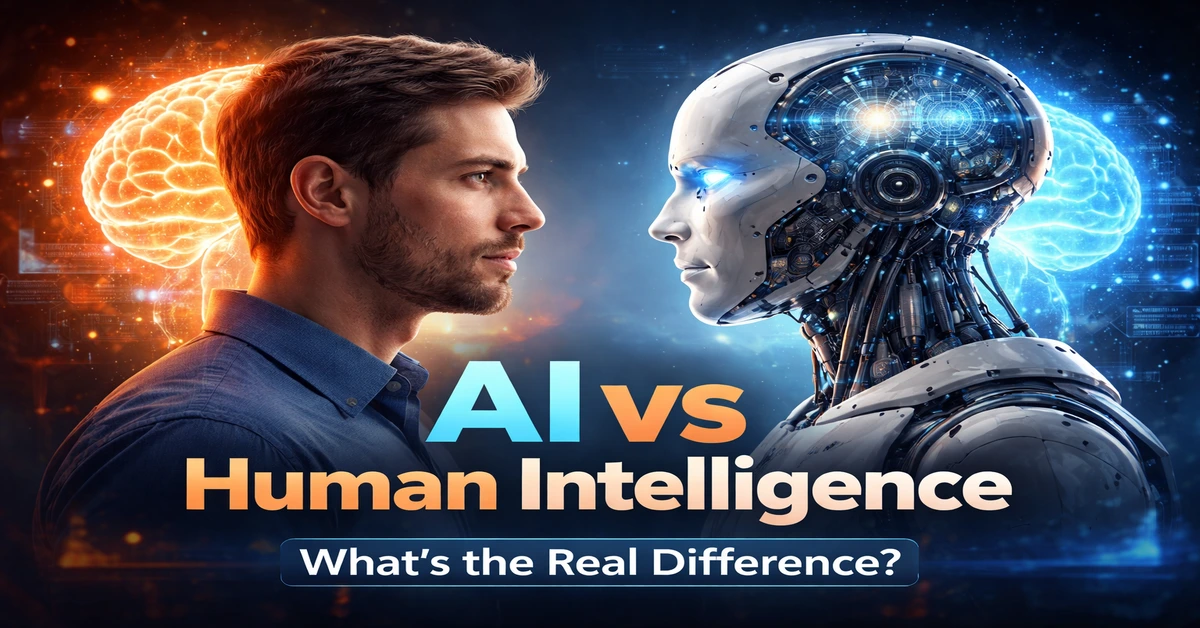
This article explains how artificial systems work, how human intelligence develops, and where the real differences lie when it comes to learning, reasoning, creativity, and decision making. This article also explores the ongoing debate of ai vs human intelligence and how these two forms of intelligence shape our future.
What Is Artificial Intelligence and How Does It Work?
Artificial intelligence refers to computer systems designed to perform tasks that normally require human thinking. These systems rely on algorithms, data, and statistical models to identify patterns and produce outputs.
Most modern AI systems use machine learning. Instead of being programmed step by step, they learn from examples. If an AI model is trained on thousands of images of cats, it begins to recognise common visual patterns associated with cats. However, it does not understand what a cat is in the way a human does.
Research published by MIT Technology Review explains that AI systems operate through probability and correlation rather than understanding or awareness. They predict outcomes based on patterns in data, not meaning or intention.
In practical use, AI tools are excellent for speeding up repetitive tasks. I personally use AI to summarise reports or organise large datasets. It saves time, but it often misses subtle context that a human reader notices instantly.
What Is Human Intelligence?
Human intelligence is the ability to learn, reason, adapt, and apply knowledge across different situations. It includes emotional awareness, creativity, memory, social understanding, and ethical judgment.
Humans learn not only from information but from lived experience. A single mistake, conversation, or emotional moment can permanently change how someone thinks or behaves. This type of learning does not rely on massive datasets.
According to research referenced by Stanford Encyclopedia of Philosophy, human cognition integrates emotion, perception, memory, and reasoning in a deeply interconnected way. This allows humans to make decisions even when information is incomplete or uncertain.
AI vs Human Intelligence: Core Differences Explained
The difference between artificial intelligence and human intelligence becomes clearer when considering flexibility. AI operates within predefined goals and constraints. Humans can redefine goals, question assumptions, and change priorities based on values or ethics.
Research published in Nature Human Behaviour shows that human reasoning relies heavily on causal understanding, while AI relies on correlation.
Here, we explain the core differences between AI vs human intelligence to highlight their unique strengths and capabilities.
| Features | AI Intelligence | Human Intelligence |
|---|---|---|
| Nature | Machine-based, data-driven | Biological, emotion-driven |
| Learning | Learns through algorithms, data, and patterns | Learns through experiences, emotions, and reasoning |
| Problem Solving | Solves predefined problems based on data inputs | Can solve novel, complex problems with creativity |
| Speed | Processes information rapidly and efficiently | Processes slowly, influenced by cognitive load |
| Memory | Unlimited data storage, precise recall | Limited memory, influenced by emotions and bias |
| Adaptability | Limited to its programming and data | Highly adaptable, learns from environment and context |
| Emotions | Lacks emotions or subjective experiences | Rich emotional responses and empathy |
| Creativity | Limited to generated solutions based on patterns | Can think outside the box, creating new ideas |
AI vs human brain: How Information Is Processed
The AI vs human brain comparison often creates confusion because artificial neural networks borrow terms from neuroscience. Despite the naming similarity, the functioning is very different.
The human brain contains billions of neurons and forms connections dynamically throughout life. It processes emotion, memory, sensory input, and abstract thought simultaneously. AI systems process information sequentially and require significant computational resources to handle complex tasks.
According to Harvard Medical School, the human brain remains unmatched in adaptability and energy efficiency, even compared to advanced computing systems.
Can AI think like humans?
Many people ask whether AI can think like humans. The answer is no.
AI can simulate conversation, reasoning patterns, and even creativity, but it does not possess consciousness or self awareness. It does not experience curiosity, doubt, fear, or intention. What appears as thinking is simply the output of mathematical models.
Research from The Alan Turing Institute confirms that current AI systems do not understand meaning or context in the way humans do.
Human intelligence vs artificial intelligence examples:
Real world human intelligence vs artificial intelligence examples highlight where each performs best.
AI outperforms humans in analysing massive datasets, detecting patterns in medical scans, and forecasting trends based on historical data. Humans outperform AI in leadership, empathy, ethical reasoning, and creative problem solving.
For example, AI can assist doctors by flagging abnormalities in scans. However, only a human doctor can explain the diagnosis with empathy and weigh ethical considerations. Reports from the World Economic Forum consistently show that emotional intelligence remains a uniquely human advantage.
Limitations of AI compared to humans:
Understanding the limitations of AI compared to humans is essential for responsible use.
First, AI lacks contextual understanding. It struggles when faced with situations outside its training data.
Second, AI has no emotional intelligence. It can mimic emotional language but does not feel empathy or moral concern.
Third, AI depends heavily on data quality. Biased or incomplete data can lead to flawed outcomes. Research from the Oxford Internet Institute shows that AI systems often amplify existing data bias rather than eliminate it.
Humans can recognise bias, question sources, and apply judgment beyond numbers.
AI vs human intelligence comparison in Decision Making:
AI vs human intelligence comparison in decision making shows clear differences.
AI decisions are driven by efficiency, probability, and optimisation. Human decisions consider long term consequences, ethics, social impact, and emotional factors.
For example, an AI system might recommend cost reductions to maximise profit. A human leader may reject that recommendation to protect employee wellbeing or brand trust.
According to McKinsey Global Institute, organisations that combine AI insights with human judgment achieve better outcomes than those relying on automation alone.
Will AI replace human intelligence?
The question of AI replacing human intelligence entirely is common, but evidence suggests this is unlikely.
AI will replace certain tasks, particularly repetitive or data heavy ones. However, intelligence as a whole includes creativity, ethics, leadership, and emotional understanding. These areas remain difficult to automate.
Research from the OECD indicates that future jobs will increasingly involve collaboration between humans and AI rather than full replacement.
How Humans and AI Can Work Together?
The most realistic future is one of cooperation. AI enhances speed, scale, and accuracy. Humans provide purpose, creativity, and judgment.
In writing, AI can assist with structure or drafting. Humans shape voice, intent, and meaning. In healthcare, AI supports diagnosis while humans deliver care and compassion.
When used responsibly, AI becomes a tool that amplifies human intelligence rather than competes with it.
Final Thoughts: Understanding the Real Difference in AI vs Human Intelligence
The comparison of AI vs human intelligence is not about which is superior. It is about understanding strengths and limits.
AI excels at computation, pattern recognition, and efficiency. Human intelligence excels at meaning, creativity, ethics, and adaptation. Recognising these differences allows individuals and organisations to use AI wisely while preserving the qualities that make human intelligence irreplaceable.
FAQs about AI vs Human Intelligence:
The main difference between AI and human intelligence is how thinking and learning occur. AI relies on data patterns and algorithms, while humans learn through experience, emotion, and reasoning. Human intelligence includes judgment and understanding that AI does not possess.
AI cannot think or reason like humans. It can simulate reasoning by identifying patterns in data, but it does not understand meaning, emotions, or context the way humans do.
AI is not smarter than human intelligence overall. It can outperform humans in specific tasks such as data analysis or pattern recognition, but humans remain superior in creativity, ethics, emotional intelligence, and complex decision making.
The limitations of AI compared to humans include lack of emotional understanding, inability to apply common sense, dependence on data quality, and limited adaptability in unfamiliar situations
AI is unlikely to replace human intelligence entirely. It will automate certain tasks, but human creativity, empathy, ethical judgment, and leadership remain essential and difficult to replicate.