A few years ago, one of my clients asked me a simple question.
“If we stop running ads tomorrow, what do we still own?”
That question changed how we approached marketing.
Paid ads disappear the moment the budget stops. Social media reach fluctuates. But helpful, well written content continues working quietly in the background. It builds traffic. It builds trust. And most importantly, it builds relationships.
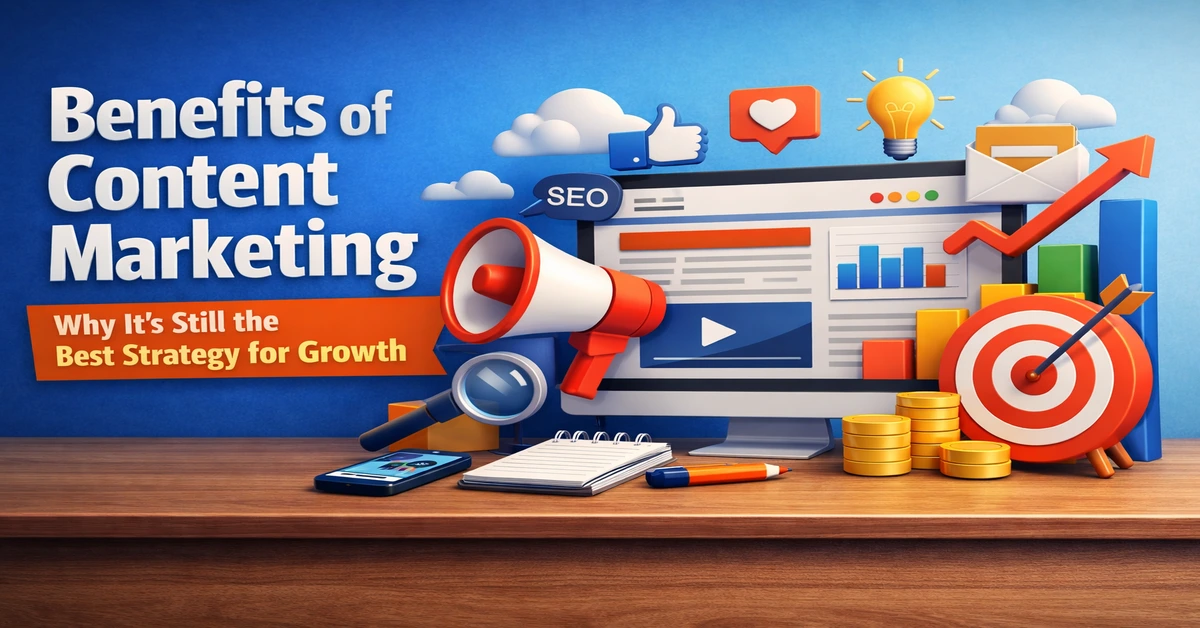
That is why the benefits of content marketing continue to stand strong even as marketing trends evolve.
If you are new to the fundamentals and want a complete breakdown of what it actually means, you can read our detailed guide here: What is Content Marketing? Meaning, Benefits and Importance
This article, however, focuses on something deeper. Not definitions. Not surface level ideas. We are going to talk about growth, ROI, authority, and long term business impact.
What Makes the Benefits of Content Marketing So Powerful
The benefits of content marketing go beyond publishing blog posts. At its core, it is about building assets that continue delivering value over time.
Unlike promotional campaigns that interrupt users, content supports decision making. It answers real questions, removes friction & builds credibility.
And the numbers support this.
According to research published by Forbes, 90 percent of marketers use content marketing as part of their overall strategy. (Forbes)
That is not a small majority. That is industry wide adoption.
Why? Because it works.
In my own experience working with service brands and ecommerce companies, consistent publishing increased organic traffic by more than 200 percent within a year. But more importantly, customer trust improved. Sales conversations became easier because prospects already understood the value.
That is the quiet strength behind content marketing.
The Importance of Content Marketing in Modern Business:
The importance of content marketing lies in how buyers behave today.
Before contacting a company, most people research. They compare, read reviews & look for helpful information.
Research shows that 47 percent of buyers consume three to five pieces of content before speaking with a sales representative. (Wifitalents)
Think about that for a moment.
Nearly half of your future customers are educating themselves before you even know they exist.
If your brand is not present during that research phase, someone else is.
This is where content marketing becomes essential to your digital marketing strategy. It ensures you show up when your audience is actively looking for answers.
When we mapped content topics around real customer questions for a B2B client, inbound leads doubled within six months. Not because we pushed harder. But because we provided clarity earlier in the journey.
Building a Content Marketing Strategy That Supports Growth:
A content marketing strategy is not about publishing randomly. It is about structure.
A documented content marketing strategy increases accountability and results. Studies show that brands with a documented content strategy are twice as likely to report success compared to those without one. (Zipdo)
From my experience, the difference is focus.
A strong strategy includes:
• Audience research
• Keyword and intent mapping
• Topic clusters
• Consistent publishing schedule
• Performance tracking
Without structure, content becomes noise. With structure, it becomes a long term marketing strategy that compounds over time.
Content Marketing for Business Growth Is Measurable
There is a misconception that content is difficult to measure. In reality, content marketing for business growth is one of the most trackable approaches available today.
Research shows that content marketing generates three times more leads than traditional outbound marketing while costing 62 percent less.(Wifitalents)
Let that sink in.
Three times more leads.
At significantly lower cost.
I have seen this happen repeatedly. One ecommerce brand shifted budget from aggressive paid acquisition to high quality informational content. Within eight months, organic sales accounted for over 40 percent of total revenue.
That is content marketing ROI in action.
SEO and Content Marketing Work Together:
SEO and content marketing are deeply connected. Without content, there is nothing meaningful to rank. Without SEO, even strong content may struggle to reach the right audience.
Organic search remains the primary traffic source for most websites. In fact, studies indicate that over 53 percent of website traffic comes from organic search. (Forbes)
This makes SEO and content marketing inseparable.
Search engines reward expertise, depth, clarity, and relevance. That aligns perfectly with EEAT principles.
When content demonstrates experience and authority, rankings improve naturally. And when rankings improve, sustainable traffic follows.
Lead Generation Through Content That Builds Trust:
Instead of interrupting others, the content attracts others who are already interested.
As per the marketing survey, businesses that focus on blogging have a 13-time probability to experience positive ROI. (Marketingltb)
This means, for instance, that helpful guides, comparison articles, and educational resources cultivate potential customers without pressure.
For instance, we have a SaaS company that created a library helping to answer customer objections. In this case, the demand for demos increased within months due to the customers being informed.
“Content does not force decisions. It supports them.”
Brand Awareness Through Content Builds Authority:
Content is king for growing brand awareness through consistency and value.
When people repeatedly see your insights across search engines and social platforms, familiarity increases. Familiarity begets trust.
Research by Wifitalents indicates that 70 percent of consumers would prefer to learn about a company through articles instead of advertisements.
That matters for a preference.
With content, you get to convey expertise without being promotional. If done consistently, this positions your brand as a trusted source of information in your space.
Authority is not claimed, it is earned.
Inbound Marketing Benefits Reduce Long Term Costs:
The advantages of inbound marketing become apparent when considering its cost structure.
The cost of paid campaigns demands constant spending. The inbound assets, however, continue to work long after publication.
Research by Wifitalents indicates that it is 61 percent cheaper per lead compared to outbound marketing.
Such a difference can have a significant impact on sustainability.
When the content reliably generates qualified visitors, the need for paid channels is minimized. The marketing process makes more sense.
Measuring Content Marketing ROI Clearly:
Content marketing ROI can be measured with:
- Engagement metrics
- Improvements in conversion rate
- Assisted Conversions
- Customer lifetime value
According to industry data, such marketing tactics can generate as much as between 2.77 and more than 6 dollars per dollar invested based on execution (Zipdo).
These returns grow over time because content assets have compounding value.
A blog article created today may be generating leads three years from now, and very few marketing tactics enjoy this benefit.
Why Content Marketing Remains the Strongest Long Term Marketing Strategy?
Marketing trends change fast: algorithms change, platforms come and go.
However, the nature of human behavior remains the same. People always seek answers, always compare, always want reliable information.
It is in line with that nature.
Benefits:
- Higher quality leads
- Stronger brand trust
- Lower Long Term Acquisition Costs
- Measurable content marketing ROI
This is the reason it is part of all important digital marketing plans.
Final Thoughts on the Benefits of Content Marketing:
Once you remove all of the tactics and tools, the value of content marketing gets boiled down into something simple: trust built over time. It’s not about publishing for the sake of filling a calendar. It’s about answering real questions, showing real expertise, and being consistently helpful.
I have seen companies pursue short-term gains via ads, only to start over from scratch the moment budgets stopped. Brands with a consistent content marketing approach continue to build momentum with each passing month: their traffic rises, their authority does likewise, and their audience starts to position them as a source they can rely upon.
The benefits of content marketing are steady and compounding, not dramatic or overnight. And in business, steady growth usually outperforms quick spikes.
FAQs about Benefits of Content Marketing:
The benefits of content marketing include long term traffic, stronger brand authority, better lead generation through content, and improved content marketing ROI. It builds trust and reduces reliance on paid ads.
Content marketing for business growth increases visibility, builds credibility, and attracts high intent buyers. A strong content marketing strategy supports consistent, sustainable growth.
Lead generation through content works by targeting search intent. Helpful, optimized content attracts users actively looking for solutions, increasing conversions.
Content marketing supports long term marketing strategy, while paid ads provide short term traffic. SEO and content marketing together create lasting, compounding growth.
Most businesses see early results within three to six months. The full benefits of content marketing usually appear after six to twelve months of consistent publishing.