Picture this. A local clothing boutique in Indore sends the same Diwali sale email to everyone on its list. The college student who once bought a Rs 500 dupatta gets the same message as the loyal customer who spends Rs 8,000 every season. The student does not open it. The loyal customer, who would have loved a personalised offer on the sarees she keeps browsing, switches to a competitor that actually remembered what she likes.
That competitor is not bigger. They are not spending more. They are just using AI personalization.
Brands personalizing campaigns with AI are seeing two to three times higher conversion rates compared to one-size-fits-all strategies (Spinta Digital, 2026). And 64% of Indian SMBs now report that AI has levelled the playing field, allowing them to produce professional campaigns and compete effectively against larger businesses (Cloud 9 Digital, 2026).
How to create a digital marketing strategy walks through that step before you layer AI personalization on top.
What is AI Personalization in Marketing?
The plain language definition
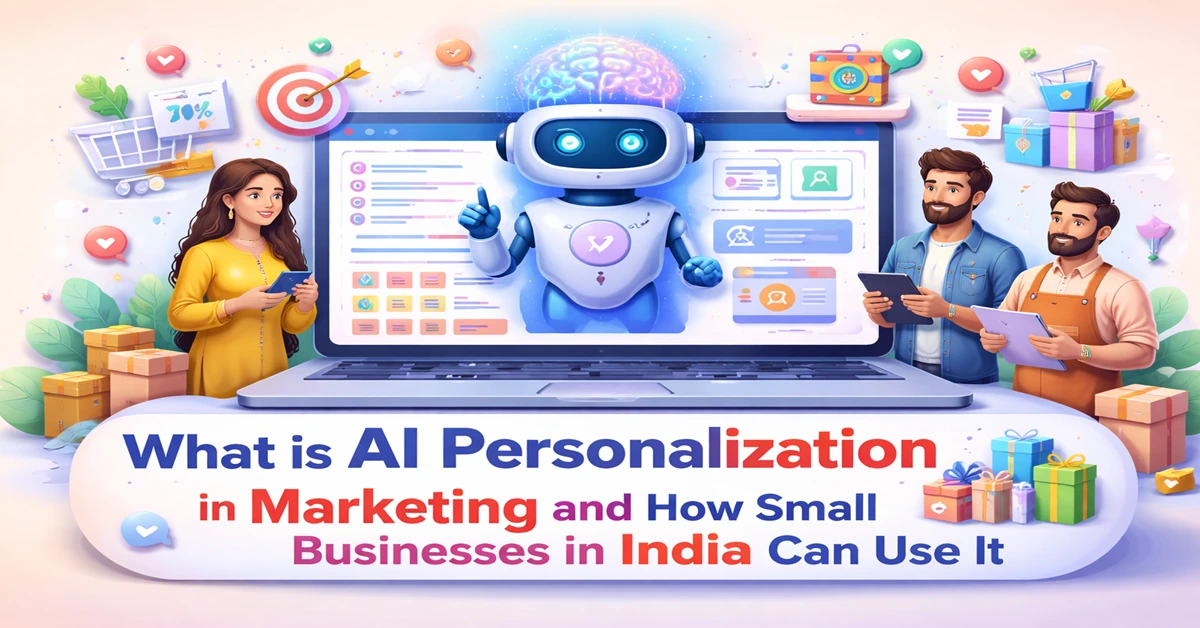
AI personalization in marketing means using artificial intelligence to automatically deliver different content, products, offers, or messages to different customers based on their individual behaviour, preferences, and history rather than sending the same thing to everyone.
The opposite is broadcast marketing. One email blast to your entire list. The same ad for every visitor. The same homepage regardless of whether someone is buying for the first time or the fifteenth. Most Indian small businesses in 2026 are still doing this and quietly losing sales because of it.
How AI personalization in marketing actually works
The mechanics are simpler than they sound. Three things happen in sequence.
- The AI collects data: Which pages a visitor viewed, how long they stayed, what they searched, what they bought, when they usually browse, what device they use, and what language they prefer.
- The AI finds patterns: It notices that customers who browse your cotton kurta section on Friday evenings and also visit your sale page are significantly more likely to buy if they receive a WhatsApp message Saturday morning with a limited offer. It discovers this across hundreds of customers simultaneously without anyone manually analysing a spreadsheet.
- The AI acts automatically: It delivers the right message to the right person at the right moment without you having to do anything manually for each individual customer.
| Quick test: If your tool requires you to manually enter every customer’s preferences, it is a well-designed spreadsheet rather than AI personalization. Genuine AI does the pattern recognition and the delivery automatically as your customer list grows. |
Basic personalization vs AI personalization: the real difference
| Basic personalisation | AI personalisation |
| “Hi Priya” in an email subject line | “Hi Priya, the blue kurta you saved last Tuesday is 20% off today” |
| Same festival discount email to everyone | Different messages based on each person’s purchase history and preferences |
| Manual list segmentation by city or gender | Automatic micro-segmentation by behaviour, timing, language, and purchase intent |
| Works for 500 contacts with significant manual effort | Works for 50,000 contacts with the same setup effort |
| Static: set it once and forget it | Dynamic: improves automatically as more data comes in |
Why AI Personalization in Marketing Matters More Than Ever for Indian Small Businesses
78% of Indian businesses now use AI for marketing in some form, up from 45% in 2024 (Cloud 9 Digital, 2026). The adoption gap between metros and tier-2 cities has shrunk from 45% to just 23% in two years. The competitive environment is shifting fast, and the businesses establishing personalised systems now will have a meaningful head start over those who start 12 months from now.
| 2-3x | higher conversion rates for brands using AI personalisation vs one-size-fits-all campaigns (Spinta Digital, 2026) |
| 156% | higher growth in vernacular AI content in Hindi, Telugu, and Tamil in tier-2 and tier-3 cities vs English-only content |
| 34% | higher email open rates from AI-powered subject line personalisation compared to static subject lines |
| 369% | potential increase in average order value from AI-powered product recommendations in e-commerce |
Three India-specific reasons this matters right now:
- Language and regional diversity is a personalization opportunity most businesses ignore: India has 22 official languages and deeply different cultural contexts across regions. A message in Marathi to a customer in Nagpur lands completely differently than the same message in English. Tier-2 and tier-3 cities show significantly higher engagement with vernacular content. Small businesses that personalise by language and region have an advantage that even large national brands struggle to replicate at scale.
- Indian consumers respond to timely relevance more than to discount size: A 15% offer delivered at the right moment to the right person outperforms a 30% blanket discount sent to everyone. AI learns when each individual customer is most likely to respond and acts on that pattern automatically.
- Mobile-first behaviour generates rich personalization data constantly: Over 95% of Indian internet users access the web primarily on mobile. Every tap, scroll, and search leaves a data trail that AI uses to build an individual customer profile. Small businesses with even modest customer lists are sitting on more useful data than they realise.
5 Ways Indian Small Businesses Can Use AI Personalization Right Now
Each of the five approaches below works independently. You do not need all five. Start with the one that fits your current highest-traffic customer touchpoint.
1. Personalised email marketing
Email remains one of the highest-ROI marketing channels for Indian small businesses when done with personalisation. AI-powered subject line testing yields 34% higher open rates, with tools analysing emotional triggers, length, and personalisation elements. Predictive analytics also determine optimal send times for individual subscribers rather than sending everyone at the same time.
In practice this means: instead of sending the same Diwali sale email to your entire list, AI automatically segments it. Customers who opened your last three emails receive an early access VIP message. Customers who have not bought in 60 days receive a gentle win-back offer with a small incentive. New subscribers receive a welcome sequence tailored to the product category they first showed interest in. None of this requires manual work on your end once the initial setup is done.
| Recommended tools: Mailchimp (free up to 500 contacts, AI subject line suggestions built in) • Brevo (free up to 300 emails per day) • Kit (free for basic automation, strong for content businesses) |
2. Personalised WhatsApp campaigns
WhatsApp is the single most important personalisation channel for most Indian small businesses because it is where Indian customers already spend significant time and hold high trust. AI tools integrated with the WhatsApp Business API segment your opted-in contacts automatically by purchase history, city, language preference, and browsing behaviour, then send each group a genuinely different message.
A saree shop in Varanasi can send a Kanjeevaram silk collection update only to customers who previously bought silk, while sending a cotton collection message to customers whose purchases lean toward casual wear. Both messages come from the same account with the same effort. The difference in relevance is significant.
AI WhatsApp marketing for Indian businesses.
| Recommended tools: Interakt (from Rs 999/month, WhatsApp Business API with built-in AI segmentation) • AiSensy (from Rs 999/month, strong for D2C and e-commerce) |
3. Personalised product recommendations on your website
A visitor from Chennai who has previously bought traditional jewellery should see a completely different homepage from a visitor in Delhi who bought western accessories last month. AI product recommendation engines make this happen automatically by analysing browsing history, purchase patterns, and what similar customers bought.
The impact can be substantial. AI personalisation increases conversion rates by up to 10% in e-commerce, and AI-powered product recommendations have been shown to increase average order value by up to 369% in some retail categories. For a small business this is not a marginal improvement.
| Recommended tools: Shopify AI Recommendations (included in standard Shopify plans) • Findify for Shopify stores • WooCommerce Product Recommendations plugin for WordPress-based stores |
4. Personalised social media and Google advertising
Meta’s Advantage+ and Google’s Performance Max both use AI to automatically create personalised ad variations for different customer segments. You provide the raw materials, your product images and key messages, and the AI handles which version to show to which person and when, testing hundreds of combinations simultaneously to find what converts for each audience segment.
A practical note for Indian small businesses: when setting up Meta Advantage+, upload at least five to six creative variations, and include at least one in Hindi or the primary regional language of your target market. AI personalisation multiplies the impact of diverse inputs. The more variation you give it, the better the personalisation quality.
| Recommended tools: Meta Advantage+ (minimum Rs 300/day ad spend) • Google Performance Max (minimum Rs 300/day ad spend, manages search, display, and YouTube simultaneously) |
5. Personalised chatbots and conversational AI
A personalised chatbot remembers returning visitors, knows what they previously bought, and adjusts its conversation accordingly. A customer who complained about delayed delivery last time gets routed to priority support automatically. A frequent buyer gets a loyalty discount offered proactively in the chat window before they even ask.
52% of customer interactions now involve AI chatbots, with satisfaction scores reaching 84%. 90% of businesses report faster complaint resolution after implementing chatbots (Loopex Digital, 2026). For small teams that cannot staff a support line 24 hours a day, a well-configured AI chatbot handles the bulk of routine queries while escalating complex ones to a real person.
| Recommended tools: Tidio (free for up to 50 monthly conversations) • Freshchat (free for small teams) • Intercom (best for businesses handling 500+ monthly conversations) |
Free and Affordable AI Personalization Tools for Indian Small Businesses
Here is everything in one place for quick comparison.
| Tool | What it personalises | Free tier | Paid from | Best for |
| Mailchimp | Email content, timing | Up to 500 contacts | Rs 800/month | Email campaigns |
| Brevo | Email and SMS | 300 emails/day | Rs 1,100/month | Email plus SMS |
| Interakt | WhatsApp messages | No | Rs 999/month | WhatsApp personalisation |
| AiSensy | WhatsApp broadcasts | No | Rs 999/month | D2C and e-commerce |
| Meta Advantage+ | Facebook and Instagram ads | No (ad spend required) | Rs 300/day min | Social media ads |
| Google Perf Max | Google search, display, YouTube | No (ad spend required) | Rs 300/day min | Multi-channel ads |
| Tidio | Website chatbot | Up to 50 chats/month | Rs 1,500/month | E-commerce support |
| Shopify AI | Product recommendations | Included in Shopify | Part of plan | Product pages |
How to Start with AI Personalization This Week: A Practical Four-Week Plan
This plan is deliberately simple. One task per week. No technical background needed.
Week one: Audit the data you already have
Most Indian small businesses have more useful customer data than they realise. Check your email list for purchase category information. Look through your WhatsApp Business chat history for the questions customers ask most often. Pull your Google Analytics or Shopify data to see which pages visitors spend the most time on and where they drop off. This audit costs nothing and takes a few hours. It reveals the patterns the AI needs to start working.
Week two: Pick one channel and one tool
Do not attempt to personalise everything at once. Pick the channel where your customers are most active, which for most Indian small businesses is either email or WhatsApp, and sign up for one free or affordable tool. Set up one simple personalisation to start: a different welcome message for first-time subscribers versus returning customers, or a different WhatsApp follow-up for customers who have not bought in 45 days.
Week three: Set up your first automated flow
The three flows with the highest immediate impact for Indian small businesses are:
- Welcome sequence: For new email subscribers, ask one preference question in the first email and use the answer to personalise everything that follows.
- Browse abandonment: For website visitors who looked at a product but did not add it to cart, send an automated follow-up 12 to 24 hours later.
- Win-back message: For customers who have not bought in 60 to 90 days, send a gentle re-engagement message with a relevant product suggestion based on their last purchase.
Week four: Measure and learn
Check open rates, click rates, and conversion rates for your personalised messages against your previous broadcast messages. Even basic personalisation typically shows 20 to 40% improvement in engagement within the first four weeks. Use those numbers to decide which second channel to personalise next.
Common Mistakes Indian Small Businesses Make with AI Personalization
Starting without enough data
AI needs a minimum dataset to detect meaningful patterns. If you have fewer than 200 customers or subscribers, manual segmentation is actually more effective than AI at this stage. Wait until your list or customer base is large enough for behavioural patterns to be statistically reliable before investing in AI personalisation tools.
Personalising too aggressively
There is a meaningful difference between a message that feels genuinely helpful and one that feels like surveillance. Showing someone an ad for a product 30 seconds after they viewed it on your website feels intrusive to many Indian consumers. A follow-up 12 to 24 hours later feels helpful and natural. Get the timing right before you worry about the content.
Ignoring regional language
Running all your personalised content in English when your customers are in non-metro India means the personalisation is doing only half of its potential job. Even adding Hindi subject lines to emails for customers in Hindi-speaking states can meaningfully improve open rates. The data on vernacular AI content performance in tier-2 and tier-3 cities makes this one of the clearest opportunities available to Indian businesses right now.
Forgetting DPDP compliance
Ministry of Electronics and IT official website. This is increasingly enforced and the risk of ignoring it is growing.
AI Personalization in Marketing: Your Competitive Advantage Is Waiting
The gap between what large Indian brands can do with AI and what small businesses can access has narrowed more in the last 12 months than in the previous five years. The tools are available, the costs are genuinely accessible, and the results are measurable within weeks rather than months.
AI personalization in marketing is not about technology for its own sake. It is about being genuinely relevant to each customer at the right moment. In a crowded market where every competitor is sending the same festival sale to the same list, relevance is the most powerful competitive advantage a small business can have.
Creating a complete digital marketing strategy & when you are ready to personalise your WhatsApp channel specifically, our detailed guide on AI WhatsApp marketing for Indian businesses covers the exact setup process from start to finish.
Pick one channel. Set up one personalised flow this week. Give it 30 days and measure what changes. The businesses winning in India’s digital economy right now are not the ones with the largest budgets. They are the ones who stopped broadcasting at their customers and started having relevant conversations with them.
Blog Arena 360 is built around real experiences from real Indian businesses. Visit our Write for Us page to share your story with our audience.
Frequently Asked Questions About AI Personalization in Marketing
AI personalization in marketing means using artificial intelligence to automatically deliver different content, offers, and messages to different customers based on their individual behaviour and purchase history, rather than sending the same message to everyone. The AI collects data, finds patterns, and acts on those patterns automatically without you having to manually manage each customer relationship.
Yes. Many of the most effective tools have free tiers that work well for businesses with fewer than 1,000 customers. Paid plans for tools like Mailchimp, Brevo, and Interakt start between Rs 800 and Rs 1,500 per month. For most small businesses the improvement in conversion rates makes this investment straightforward to justify within the first few weeks.
Not for the tools listed in this guide. Mailchimp, Interakt, and Tidio all have drag-and-drop interfaces designed for non-technical users. Setting up your first personalised email or WhatsApp automation typically takes a few hours with no coding involved. The main requirement is having a clear idea of which customer segments you want to communicate with differently.
Yes, as long as you collect customer data with explicit consent and maintain a clear privacy policy. The Digital Personal Data Protection Act 2023 requires informed consent before using customer data for personalised marketing. All the tools listed in this guide have standard data protection compliance built in, but you are responsible for ensuring your own data collection processes include proper consent mechanisms.
Most businesses see measurable improvement in email open rates and click-through rates within four to six weeks of setting up basic personalisation. WhatsApp personalisation often shows results faster because the baseline engagement rate on WhatsApp is already high in India. Product recommendation personalisation typically takes two to three months to show significant conversion improvements as the AI builds a sufficient dataset.
Not at all. Coaching institutes use it to personalise follow-up messages based on which course a prospective student enquired about. Real estate agents use it to show different property listings based on stated budget and location preference. Healthcare clinics use it to send relevant health content based on the reason for a previous appointment. Any business with repeat customers or multiple product or service categories can benefit from AI personalisation.
| Disclaimer: This article is for informational and educational purposes only. Tool pricing and features change regularly. Verify current details on each platform’s official website before making purchasing decisions. AI personalization results vary depending on your customer base size, data quality, and implementation approach. |