A few years ago, one of my e-commerce clients called me in a panic before their festive sale. Customer inquiries were already flooding in, and the campaign hadn’t even gone live yet. This is when we seriously considered using AI chatbots. At this stage in time, many entrepreneurs still associated chatbots with robotic and annoying messages. Today, these chatbots are far more advanced, intelligent, and capable of handling heavy conversations.
Exploring the capabilities of AI chatbots can transform customer interactions and streamline business operations. These chatbots also offer innovative solutions for various industries, enhancing the overall customer experience.
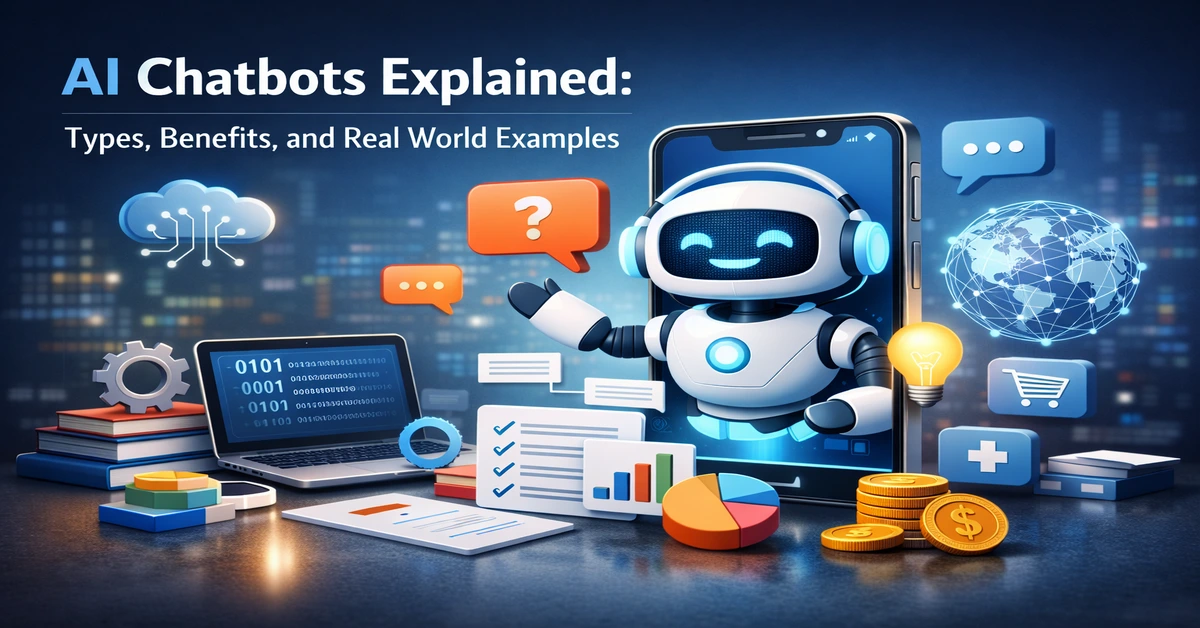
In this article, we’ll define AI chatbots, explain their meaning in simple terms, explore how they work, discuss their types, evaluate their advantages, and examine real-world applications, backed by credible research and facts.
What Is an AI Chatbot in Simple Words?
AI chatbots leverage advanced algorithms to provide timely responses and improve user satisfaction.
Let’s start with the basics.
When asked what an AI chatbot is in simple terms, the simplest definition would be this:
An AI chatbot is a computer program that is able to understand human language and talk back in a conversational manner.
With the rise of chatbots, businesses can automate processes while maintaining a personal touch in customer interactions.
That’s the simple explanation. The formal definition of an AI chatbot is this: it is a software application that uses artificial intelligence technology in order to simulate a human conversation using natural language processing and machine learning algorithms.
The definition of an AI chatbot is more than just an auto-response feature. The traditional chatbot was purely based on automated scripts. The new one is based on interpretation of intent, context, and language variations. This is what made a simple bot an intelligent chatbot that can have dynamic conversations.
If you are new to the concepts of artificial intelligence, I would recommend reading before exploring more about conversational AI.
How AI Chatbots Work?
Learning about the workings of AI chatbots can go a long way in demystifying them.
From a technical perspective, most sophisticated chatbots integrate the following:
- Natural Language Processing
- Machine Learning
- Large Language Models
- Data training and feedback loops
When a user sends a message, the first thing the system does is process it using Natural Language Processing. This enables the chatbot to understand the intent, key words, and context of the message. It then responds accordingly based on patterns it has learned during training.
Organizations such as IBM and OpenAI have made tremendous breakthroughs in language models, which power most AI chatbots in use today.
The adaptability of AI chatbots allows them to continuously improve based on user interactions, making them more effective.
As a result, AI chatbots are becoming essential tools for businesses aiming to enhance operational efficiency.
According to research by Gartner, conversational AI is becoming a key customer engagement interface, with most firms focusing on automation in service delivery. You can access their research findings here:
From a technical perspective, when a customer sends the message “Where is my order?”, the chatbot recognizes the intent is related to tracking the order, pulls the relevant information from the database, and responds accordingly in natural language.
From experience, quality of implementation is more important than the hype. A poorly trained system annoys customers. A well-trained system improves efficiency without customers even realizing that automation is involved.
Types of AI Chatbots:
Understanding the capabilities of AI chatbots can help businesses optimize their customer service strategies.
Ultimately, AI chatbots are revolutionizing the way we engage with technology and provide services to customers.
Not all AI chatbots are the same. Understanding the different types helps businesses choose the best option.
1. Rule-Based Chatbots:
These chatbots follow a rule-based system, providing pre-programmed responses when a user query matches a set trigger. While ideal for handling FAQs and structured processes, they struggle with complex or unexpected queries.
2. Menu Driven Chatbots:
Menu-driven chatbots guide users to select from buttons or menus, reducing ambiguity. They are particularly effective in sectors like banking and telecom, where structured options are needed.
3. AI-Powered Chatbot Systems:
An AI-powered chatbot system uses machine learning to understand open-ended queries. These systems learn and improve over time by analyzing data.
For instance, conversational AI systems developed by Microsoft and Google enable the integration of AI assistants with business platforms.
4. Intelligent Chatbot Models:
An intelligent chatbot model is more than just an automated system. An intelligent chatbot model retains context from multiple messages, responds to follow-up questions, and changes tone accordingly.
Large language models, such as those developed by OpenAI, have greatly enhanced the ability of chatbots to understand context.
Chatbots vs AI Chatbots: Key Differences
A chatbot is a tool that uses a set of rules and responses. It is used for basic and simple tasks. For instance, a chatbot may be used for answering frequently asked questions or for helping users navigate menus. On the other hand, an AI chatbot uses machine learning and is thus more effective for complex conversations and for personalizing the user experience.
Below is a comparison of chatbots and AI chatbots to help you understand their differences better.
| Feature | Chatbot | AI Chatbot |
|---|---|---|
| Technology | Rule-based, pre-programmed | AI, machine learning, natural language processing |
| Response Type | Fixed, scripted responses | Dynamic, context-aware, adaptive |
| Handling Complexity | Simple, predefined queries | Complex, unpredictable queries |
| Flexibility | Limited to set options | Learns and adapts with each interaction |
| Use Cases | FAQs, customer support, simple tasks | Personalized support, dynamic conversations, troubleshooting |
| Scalability | Limited to basic tasks | Easily scales with new data, handles multiple scenarios |
| Example | Banking bots, customer service menus | Virtual assistants like Siri, Alexa, and ChatGPT |
Benefits of AI Chatbots:
There are tangible reasons why businesses implement AI chatbots. Let’s break down the actual benefits of AI chatbots, which are data-driven.
1. 24/7 Availability:
Customers demand instant service. AI chatbots run around the clock without any interruptions.
According to research published by Salesforce, a significant number of customers demand instant answers to their queries.
From personal experience, after implementing a chatbot for a retail client, the time taken to respond reduced from hours to seconds. Customer satisfaction ratings increased in a matter of weeks.
2. Cost Efficiency:
AI chatbots significantly reduce operational costs by handling repetitive inquiries. A study by Juniper Research estimated that chatbots could help businesses save billions annually through automation efficiencies.
For startups and mid-sized companies, this makes scaling support manageable without increasing payroll proportionally.
3. Improved Customer Experience:
Speed matters. Personalization matters even more. AI chatbots can analyze past interactions and tailor responses. When done correctly, customers feel supported rather than redirected.
4. Scalability:
Human teams have capacity limits. AI chatbots can handle thousands of conversations simultaneously without performance decline.
5. Data Insights:
Every interaction provides data. Businesses can analyze conversation logs to identify recurring issues, product gaps, or service inefficiencies.
Real World Examples of AI Chatbots:
Let’s move beyond theory.
E Commerce:
Retail brands use AI chatbots for order tracking, product recommendations, and returns.
According to reporting by Reuters, AI assisted shopping contributed to measurable increases in online retail performance during peak seasons.
From a consulting standpoint, I have seen checkout abandonment rates decrease after chatbot integration helped customers clarify last-minute doubts.
Banking and Finance:
Banks deploy AI chatbots to answer balance inquiries, process simple service requests, and provide policy information.
Financial institutions are increasingly leveraging AI for automation and personalization, as outlined in research by Ernst & Young.
Healthcare and Mental Health:
AI chatbots are used for symptom checking and preliminary triage. Research published through National Institutes of Health discusses both benefits and limitations of AI in health advisory systems. It is important to clarify that these tools supplement, not replace, medical professionals.
Education:
Students use AI chatbots for tutoring support and research assistance. However, responsible usage guidelines are essential to maintain academic integrity.
AI Chatbots vs Human Intelligence:
One of the most common questions is whether AI chatbots can replace humans. To understand the broader debate, you can read this comparison at AI vs Human Intelligence
AI chatbots excel at pattern recognition and speed. Humans excel at empathy, moral judgment, and creativity grounded in lived experience. In practice, the most effective systems combine both. Chatbots handle repetitive tasks. Humans address complex or emotionally sensitive issues.
Challenges and Limitations of AI Chatbots:
Balanced evaluation strengthens trust. While AI chatbots offer significant advantages, they have limitations.
Accuracy Risks:
AI models may generate incorrect information if not properly monitored.
Bias and Ethical Concerns:
Training data influences outcomes. Organizations must implement governance frameworks to mitigate bias.
Privacy Considerations:
When handling personal data, compliance with regulations such as GDPR is mandatory.
Emotional Intelligence Gaps:
Even the most advanced intelligent chatbot cannot genuinely feel empathy. It simulates conversational tone but lacks human consciousness.
The Future of AI Chatbots:
AI chatbots will likely become more multimodal, integrating voice, text, and visual inputs. Organizations including McKinsey & Company project continued AI integration across sectors.As adoption grows, governance, transparency, and user education will become increasingly important.
If you are interested in learning more about the tools you can use to experiment with AI systems, you may also find our guide to Top 5 Free AI Tools useful, as we explain some platforms that can help you understand how AI applications work.
Final Thoughts on AI Chatbots and Their Growing Impact:
AI chatbots are no longer experimental features. They are valuable assets if used properly.
We covered the definition of an AI chatbot, explained it in simple terms, explored how they work, discussed different types, and highlighted their advantages, supported by valid research.
Based on personal experience with companies using conversational AI, success is less about technology and more about effective use. Set specific goals. Train models properly. Track their performance.
These chatbots are not a replacement for human intelligence. They only improve the efficiency of operations when used properly and effectively.
With the increasing number of digital interactions, intelligent chatbot systems will continue to play an important role in customer engagement, educational assistance, and business automation.
FAQs:
AI chatbots are software tools that can have conversations with people using artificial intelligence. Instead of only following fixed scripts, modern AI chatbots understand what users are asking and respond in a natural, helpful way.
AI chatbots analyze the message a user sends, figure out the intent behind it, and then generate a relevant response. They use technologies like natural language processing and machine learning to improve answers as they interact with more users.
A regular chatbot usually follows fixed rules and responds based on pre-written answers. An AI chatbot is more advanced because it can understand context, handle different types of questions, and adapt over time.
You’ll find AI chatbots on e-commerce websites, banking apps, customer support systems, healthcare platforms, and even educational tools. Businesses use them to answer questions quickly and improve the customer experience.
Many companies use AI chatbots because they can provide instant responses, work around the clock, reduce support costs, and handle a large number of customer conversations at once.
Most AI chatbots are safe when used on trusted websites or platforms that follow proper security practices. Still, it’s a good idea not to share sensitive personal information unless you are sure the platform is secure.