
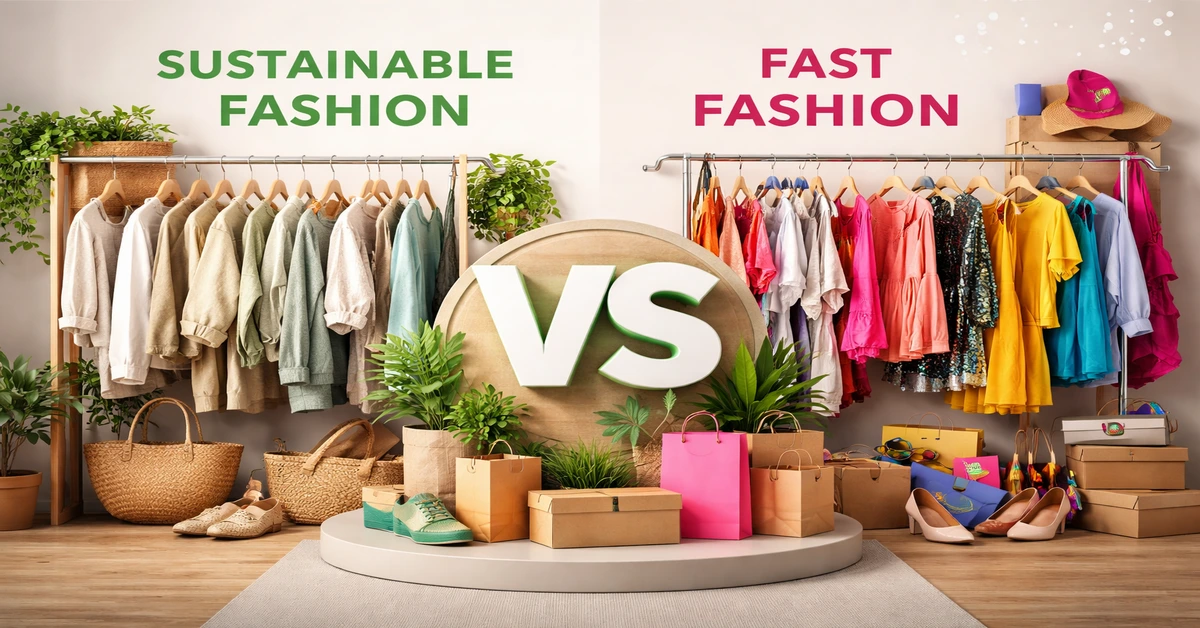
The world fashion market is at a crossroads. Clothing is no longer just about fashion or price. It’s about being good to the earth, good to workers, and good for the economy in the long term. People want to know more about their clothing. They want to know where it comes from, how it’s made, and what happens to it when they’re done with it.
When we talk about Sustainable Fashion vs. Fast Fashion, we’re talking about two very different worlds. One world is about speed. The other world is about longevity. The question isn’t which world is bigger. The question is which world has a chance to survive.
Sustainable Fashion vs Fast Fashion: Understanding the Core Difference
What Is Sustainable Fashion?
Sustainable fashion is a type of clothing that is made in a manner that is environmentally friendly, ensures ethical practices in the workplace, and is made to be used for a long period of time. The sustainable fashion industry considers the entire process of the garment from the raw materials to the point of disposal.
Fashion brands that are involved in the sustainable fashion industry consider reducing water consumption, reducing greenhouse gas emissions, and creating a safe workplace environment. Many ethical fashion brands also consider the importance of transparency.
As I have observed from my own experience among fashion readers, after investing in a high-quality product that lasts for years as opposed to months, a person’s perspective changes.
What Is Fast Fashion?
The fast fashion model prioritizes fast production and affordability. This fashion sector continuously adds new collections to its supply chain, with some collections mirroring the runway trends at relatively low prices. The model relies on fast production and frequent purchases by customers.
Although the fast fashion model promotes fashion, the environmental effects of fast fashion have become a significant issue worldwide. The low price of fast fashion products often conceals the environmental damage and exploitation of workers in the supply chain.
Environmental Impact of Fast Fashion vs Sustainable Fashion
Environmental Impact of Fast Fashion:
The impact of fast fashion on the environment cannot be ignored. According to the United Nations Environment Programme, the fashion industry contributes to about 8 to 10 percent of the world’s carbon emissions.
The fashion industry also creates about 92 million tonnes of textile waste every year, most of which ends up in landfills.The carbon footprint of the clothing industry
The carbon footprint of the clothing industry increases with the production of synthetic fibers, shipping across the world, and overproduction. The production of polyester, a fabric used in fast fashion, involves fossil fuels. It also creates microplastic pollution when the fabric is washed.
The World Wildlife Fund states that the production of a cotton shirt requires about 2,700 liters of water.
How the Sustainable Fashion Industry Responds?
Sustainable fashion addresses these problems by using recycled materials, organic materials, regenerative practices, and renewable energy. It is found that the use of a product for a long period of time reduces the emissions.
As per the State of Fashion report by McKinsey, sustainability is becoming a key driver of long-term competitiveness in the fashion sector.
More and more eco-friendly clothing brands are investing in a more circular fashion production process.
Conscious Consumerism in Fashion:
A major catalyst for this change is the rise of conscious consumerism, particularly in the fashion industry. Today, consumers are more informed and selective compared to previous years.
According to IBM’s Institute for Business Value, consumers who practice conscious consumerism are more inclined to consider sustainability an essential aspect of their purchasing decisions.
Practical questions that consumers are posing include:
- How long will this item last?
- Can this item be repaired?
- Was this item produced ethically?
Such behavior is a direct contradiction of the fast fashion industry.
Some of the people who practice conscious consumerism, particularly in the fashion industry, are those who are changing their lifestyle. For instance, instead of buying, they are opting to simplify. For women, a structured capsule wardrobe can be very helpful. It can reduce purchases and increase the versatility of outfits.
Understanding how to build your first capsule wardrobe can be very helpful, particularly for those who want to change their lifestyle.
The Slow Fashion Movement:
Slow fashion encourages consumers to engage in responsible consumption, quality craftsmanship, and timeless design. People who follow slow fashion do not feel the need to keep up with every new fashion trend.
From my experience, people who follow the slow fashion movement feel less stressed about their wardrobe. They do not need to buy clothes as often, which means there is less waste.
Slow fashion has a lower environmental impact because people are not constantly buying new clothes and then throwing them away.
Fashion Industry Sustainability Trends:
Several fashion industry sustainability trends are reshaping production systems:
- Circular economy initiatives
- Carbon accounting and emissions disclosure
- Sustainable material innovation
- AI driven demand forecasting
Technology plays a growing role. Data analytics helps brands predict demand more accurately, reducing excess inventory. You can see how automation and predictive systems are influencing production decisions in this detailed piece on AI in the Fashion Industry.
When production aligns more closely with demand, waste decreases significantly.
Governments are also introducing extended producer responsibility laws, requiring brands to manage textile waste more responsibly. These policies could dramatically reshape the fast fashion industry in the coming years.
There are a number of sustainability trends that are currently affecting the fashion industry’s production systems:
- Circular Economy Initiatives
- Carbon Accounting and Emissions Disclosure
- Innovation in Sustainable Materials
- AI-Driven Demand Forecasting
There’s definitely a role for technology here, and it’s being used to improve forecasting and reduce excess stock levels. I think you can see the role that technology and automation are playing in influencing production decisions in this detailed piece on AI and the Fashion Industry.
When production is more closely aligned to demand, there’s a much lower level of waste.
Governments are also starting to introduce extended producer responsibility legislation that will require brands to deal more sustainably with textile waste. This could have a major impact on the fast fashion industry in the future.
Business Models: Profitability vs Longevity
The Fast Fashion Industry:
However, the fast fashion business still holds the majority in terms of scale and accessibility. The production of clothing has doubled in the past two decades or so, as reported by the Ellen MacArthur Foundation.
This proves that the need for affordable fashion is still high.
However, it is a general fact that overconsumption is due to bad styling choices. This is because people still continue to purchase the same items repeatedly without planning for the long term. This is reflected in the 15 common fashion mistakes that everyone makes, which lead to the purchase of unnecessary clothing items.
The Sustainable Fashion Industry:
The sustainable fashion industry, although small in size, is growing in terms of cultural impact. Resale sites and second-hand stores are growing rapidly, which indicates the interest in reused products.
Ethical fashion brands are differentiating themselves through transparency, sourcing, and environmental goals. As investors demand more, sustainability is expected to go from being optional to being a requirement.
Carbon Footprint of Clothing Industry Comparison:
The carbon footprint of the operations of the clothing industry varies depending on the type of materials used, the process of production, and the lifespan of the product.
Fast fashion mainly uses synthetic materials and transport networks, which lead to a high carbon footprint. Sustainable fashion tries to reduce the carbon footprint by using:
- Renewable energy
- Biodegradable or recycled materials
- Longer product use cycles
Research has shown that extending the lifespan of a product reduces the environmental impact per use.
Challenges Facing Both Models:
The fast fashion industry is becoming increasingly regulated. There is also a growing reputational risk. The consumer is becoming more aware of the impact of fast fashion on the environment. As such, transparency is no longer an option but a requirement.
The sustainable fashion industry has to be careful about affordability. It has to be careful about greenwashing. Not all sustainable fashion is created equally.
The Future of Sustainable Fashion:
However, the sustainability of the fashion industry in the future would depend on its scalability and accessibility. This is because if sustainability becomes the mainstream and not an alternative, the pace at which it spreads would increase.
The sustainability trends in the fashion industry show that there is a long-term shift towards sustainability in the fashion industry. This is because there is a consensus among investors, regulators, and consumers towards sustainability.
Although the fast fashion industry is the current leader in revenue and market share, the sustainable fashion industry is the future.
Conclusion: Sustainable Fashion vs Fast Fashion
When it comes to determining which is better, Sustainable Fashion vs Fast Fashion, it all depends on how you measure success. Fast fashion is still king when it comes to sheer numbers and short-term profitability. Sustainable fashion is slowly but surely gaining ground on its competitor when it comes to legitimacy, creativity, and consumer trust.
The rise of conscious consumerism in fashion continues to grow. The slow fashion movement is changing the face of consumer spending habits. Eco-friendly clothing brands and ethical fashion brands are solidifying their position in the market.
The future of sustainable fashion is looking brighter by the day as more and more people become aware of it. It is becoming a business imperative to be accountable.
The winning formula for fashion may not be which brand can produce the most, but which brand can produce responsibly.
FAQs:
Far far away, behind the word mountains, far from the countries Vokalia and Consonantia, there live the blind texts. Separated they live in Bookmarksgrove right at the coast
The environmental impact of fast fashion includes high carbon emissions, excessive water use, textile waste, and microplastic pollution. The carbon footprint of clothing industry operations increases due to overproduction and synthetic materials.
Yes. The sustainable fashion industry is expanding as consumers shift toward conscious consumerism in fashion. Demand for ethical fashion brands and eco friendly clothing brands continues to rise, especially among younger buyers.
The slow fashion movement encourages buying fewer, higher-quality garments that last longer. It promotes mindful purchasing, wardrobe planning, and reducing waste instead of following rapid seasonal trends.
Eco friendly clothing brands often have higher upfront prices due to ethical labor and sustainable materials. However, cost per wear is usually lower because garments are designed to last longer than fast fashion alternatives.
The future of sustainable fashion depends on scalability, transparency, and consumer demand. As fashion industry sustainability trends strengthen and regulations tighten, sustainability is likely to become a standard expectation rather than a niche choice.